National Parks · Virginia
Shenandoah National Park
National Park Service source material · single source. Source dates and reuse information are available beside each field.
Check the official park website for current access, conditions and visitor information.
Introduction
Background: 1
Just 75 miles from the bustle of Washington, DC, Shenandoah National Park is a land bursting with cascading waterfalls, spectacular vistas, fields of wildflowers, and quiet wooded hollows. With over 200,000 acres of protected lands that are haven to deer, songbirds, and black bear, there's so much to explore...and your journey begins right here!
Geography
Designation: 4
National Park
State or territory: 5
Virginia
Park Map - Shenandoah National Park: 6
Map scope: Shenandoah National Park
Park map of Shenandoah National Park in Virginia. The park is a long narrow north to south S-curve with rough edges, shaded light green and pale-yellow green. Surrounding areas are white and pale yellow, with major roads noted in light gray.
History and culture
People: 7
People have lived in the Blue Ridge Mountains for at least 9,000 years. American Indians hunted and gathered game, fruit, nuts, and berries on the upland slopes. Some constructed permanent villages at the lowest elevations in the Piedmont and Shenandoah Valley outside the Park. The earliest European settlers moved into the foothills by the 1750s. These settlers moved upwards in a constant search for land on which to farm, graze livestock, and tend to orchards. In the mid to late 1800s people purchased mountain land for the extraction of resources: copper, lumber, bark for leather tanning, and water for powering mill operations. Others early saw the beauty of the Blue Ridge as a commercial product in itself, and built resorts catering to visitors from the cities. There are some groups and individuals that have left a significant mark on Shenandoah National Park. The several hundred mountain residents who lived on the land that became the Park left behind their homes and communities, forced to start anew. The Civilian Conservation Corps employed hundreds of young men to build roads and trails, to re-establish wilderness and create a park that people would come to see. George Freeman Pollock saw a business opportunity in the clean air and mountain views and established Skyland Resort , a getaway from the industrial cities nearby. Herbert and Lou Henry Hoover built their own getaway here, Rapidan Camp , as a retreat during Hoover’s often tumultuous Presidency. Park managers and visitors have played a role in Shenandoah National Park’s history. Park managers initially established segregated facilities. Black visitors could picnic and camp in Lewis Mountain, but nowhere else. Desegregation occurred officially in 1950, yet the impact of separate facilities did not vanish overnight. People from Shenandoah’s past can be found all around. If you pay close attention you may walk past the foundations of an old home site or through a cluster of apple trees that were once an orchard. You may stop at an overlook and stand on a rock wall that a young man from the CCC built years ago. Every trail and campground, every overlook and bend on Skyline Drive has been travelled before. You, our visitors today, decide what Shenandoah National Park will become for people who have yet to visit this enchanting place.
Places: 8
History in Shenandoah National Park is evident all along Skyline Drive: at overlooks with rock walls, at stone-lined ditches, at every bend in the road. Developed areas like Big Meadows, Panorama, and Dickey Ridge tell stories of what Park managers planned for Shenandoah and how those plans have changed. At Skyland imagine the colorful entertainment and the parties, the life of vacationers here before the Park was established. At Rapidan Camp listen to the river flowing and feel how Herbert and Lou Henry Hoover could have felt at their getaway in the mountains. Visit Lewis Mountain, today a quiet campground and picnic ground, but once a segregated area intended for black visitors who were prohibited from the other developed areas in Shenandoah. Contemplate the history of land preservation and public recreation on the Appalachian Trail, 105 miles of which is located right here. Don’t just take it from us; over three hundred of Shenandoah National Park’s historical structures are listed in the National Register of Historic Places. There is history everywhere in Shenandoah if you look closely.
Civilian Conservation Corps (CCC): 9
What would prompt an eighteen year old to leave home, work 5½ days a week of manual labor, in all seasons and all weather, just to earn $30 per month, out of which only $5 he could keep for himself? Answer: the Great Depression, one of the longest-lasting, most profound economic downturns in the history of the Western industrialized world. Part of President Franklin D. Roosevelt’s response to these dramatic events was for the government to adopt a variety of programs, together coined the New Deal. New Deal programs came in three categories: relief, recovery, and reform. The CCC, Civilian Conservation Corps, was a relief program funded from 1933-1942. FDR formed the CCC as a part of his First 100 Days legislation. The program was designed for the immediate relief of families with unemployed young men. Enrollment in the CCC was originally limited to unmarried, healthy men with families aged 18 to 23. The men would agree to a minimum of a six-month term of service, focusing on soil conservation and reforestation with vigorous, disciplined outdoor labor. The CCC provided uniforms, shelter, three meals a day, and training. They got paid $30/month, $25 of which was sent directly home to their parents. They got $5 for their own use! Much of the work that the Civilian Conservation Corps accomplished was located in national, state, and local parks. In 9 years the CCC planted nearly 3 billion trees and developed more than 800 parks across the United States. This work included building shelters, stocking rivers and lakes with nearly 1 billion fish, clearing beaches, digging canals and ditches, restoring historic battlefields, and countless other projects. Between May of 1933 and March of 1942, 12 CCC camps in 9 different locations opened in and around what was to become Shenandoah National Park. Each camp was home to around 200 boys at any given time. The U.S. Army controlled the camps and regimented the lived of those who lived there. During the nine years the Civilian Conservation Corps existed in Shenandoah, they helped build the infrastructure for the future national park. Their achievements included the instillation, construction, and landscaping of areas all along Skyline Drive, overlooks, picnic grounds, and developed areas.In their cumulative accomplishments are some impressive statistics:
These numbers do not reflect the high school diplomas earned, work skills taught, and lives saved through the CCC. An unanticipated consequence of work in and with the CCC was preparation for the massive call-up of civilians to military service during World War II. The more than 6,500 boys who came to Shenandoah not only created the park as we know it today, they became men who have left their legacy for our future generations to enjoy.
Skyland: 10
Decades before Shenandoah National Park was established, vacationers traveled to Skyland Resort seeking respite from urbanized, mechanized city life. The resort was created in the late 1800s and grew in popularity among middle class business people in nearby urban areas. George Freeman Pollock, dynamic and gregarious, managed Skyland with a showman's flair. His ever-present bugle awoke guests each morning, summoned them to meals and elaborate entertainments, and announced the departure of the daily mail. Pollock promoted the resort through his newspaper, The Stony Man Camp Bugle Call. Published somewhat erratically, the paper provides a glimpse into daily life at the resort we know today as Skyland. Bugle Call July 2, 1898 (343kb pdf) Bugle Call July 11, 1898 (343kb pdf) Bugle Call July 25, 1898 (1.1mb pdf) Bugle Call August 8, 1898 (1.3mb pdf) Bugle Call August 22, 1898 (1mb pdf) Bugle Call September 15, 1898 (642kb pdf) Bugle Call August 9, 1901 (344kb pdf) Bugle Call August 23, 1901 (461kb pdf)
In 1854 Samuel and Maria Williams of Brooklyn, New York purchased 21,371 acres of land in the Blue Ridge Mountains of Virginia for $4,750. One year later the land was passed on to the Virginia Cliff Copper Company for $1,000,000, although only $7,000 was ever actually tendered. Soon 5,371 acres of the tract were sold to the newly incorporated (January 1858) Stony Man Mining Company for $550,000 of stockholder funds . In 1866 the Miners Lode Copper Company (incorporated in NYC in 1865) purchased the property--its principal stockholders were Stephen M. Allen and George H. Pollock.
Although copper did exist in the area and was mined, it was not commercially successful. By 1889 Pollock and Allen were forced to obtain a $52,000 mortgage to pay their debts. The following year, convinced by Pollock's son George Freeman that the property had value for resort development, Pollock Sr. and Allen incorporated as the Stoneyman Park Preserve Lands, Inc. and began selling mortgage bonds guaranteed by building lots at the new Stoneyman Park Preserve. By the time Pollock Sr. and Allen died in 1893 over thirty building lots (at the future Skyland) had been sold. The lot sales, however, were to no avail for in 1896 the Albemarle County Courts ordered the entire property sold at public auction to satisfy the 1889 mortgage.
George Freeman Pollock convinced the Chancery Court to allow him to buy the Blue Ridge land on credit although he had no real occupation and little money. He was back before the judge again in 1900, 1902, and 1904, in each case gaining approval to sell off part of the assets to bring his debt current. By 1906 he was able to borrow, mortgage, and mortgage again enough to finally retire the 1889 mortgage and, theoretically, to gain title to the resort. In actuality Pollock never owned the Stony Man Camp/Skyland property. At the time of the establishment of Shenandoah National Park he had $67,107.22 in outstanding liens against a property ultimately appraised at less than $30,000. He received nothing for almost four decades of work on the resort and many of his creditors, as the copper stockholders years earlier, received nothing.
Pollock was not a businessman, but he was a promoter. Over the years he sold lots for and developed cabins on almost fifty lots and established the rustic architecture still seen at the resort. He established dining and recreation halls for which there were no alternatives and did guarantee some regular income, but most of all he planned and engineered elaborate balls, costume parties, teas, jousts and tournaments, musicales, pageants, and bonfires. Many of the cabin owners first came for the three-month season, but as automobiles became ubiquitous, shorter stays of a few weeks or just a few days became more common. With the advent of the Skyline Drive, day-tripping was the norm and the "old" Skyland became a thing of the past.
The Skyland Resort became the core of the new Shenandoah National Park after the National Park Service awarded the new concession contract to Virginia Sky-Line Company, Inc. in 1937. The Richmond-based company immediately began to build new facilities and to rehabilitate the earlier ones. Twelve historic Skyland structures remain and allow modern visitors to experience life at the turn of the 20 th century.
The figures and forces of the early days of Skyland Resort come to life in a tour of the recently restored 1911 cabin.
History & Culture: 11
Learning about the history of Shenandoah means learning about the lives and communities of past mountain residents, the establishment of the Park, the Civilian Conservation Corps, segregation of early park visitors, the shifting role of parks in our society, and much more. All of these subjects have a lasting impact on what Shenandoah is today and what it may become in the future.
Nature
Ecology; Nature: 12
Shenandoah National Park rises above the Virginia Piedmont to its east and the Shenandoah Valley to its west. The range of elevation, slopes, rocks, precipitation, and latitude create a mix of habitats. Tens of thousands of living creatures make their homes in the Park, from black bear resting beneath rock overhangs, to tiny aquatic insects darting through cool mountain streams. You could spend your whole life studying these amazing organisms, but let's not get ahead of ourselves. Why not start with a few minutes browsing more information about them below?
Birds: 13
More than 190 species of resident and transient birds are known to use the park. Approximately half of these species breed in the park including eighteen species of warblers. Roughly thirty bird species are year-round residents including tufted titmice, red-tailed hawks, Carolina chickadees, wild turkeys, and barred owls.
Due to the park's location along the crest of the Blue Ridge and the extent of forested habitat, Shenandoah provides essential habitat for neotropical migratory birds, both for nesting and as a travel corridor. Certain areas, such as Big Meadows, support species that can be found nowhere else in the park.
Plants: 14
Plants in the Park are protected by law and may not be disturbed or collected. However, there are some exceptions. Find out more about collecting plants and mushrooms in Shenandoah.
Animals: 15
More than 50 mammals live in Shenandoah including the white-tailed deer, black bear, bobcat, and big brown bat.
A variety of toads, frogs, newts, and salamanders live in Shenandoah, including the endangered, Shenandoah Salamander.
Insects, spiders, centipedes, and millipedes are all around. Some, like butterflies, are well researched, but others remain misunderstood.
Twenty-six species of reptiles live in Shenandoah including the eastern box turtle, timber rattlesnake, and broad-headed skink.
Shaded forest slopes give rise to clear, cold water, making excellent habitat for the 41 fish species recorded in Shenandoah.
Ecosystems: 16
Shenandoah is the largest fully protected area in the mid-Appalachian region and includes 300 square miles of the Blue Ridge Mountains. The Park’s biota and natural features include well-exposed strata of the Appalachians, diverse animal and plant populations and habitats migratory bird stop-over points and forested watersheds that perpetuate numerous streams flowing from uplands to lowlands.
This seemingly ubiquitous forest, covering 95% of Shenandoah, is an ever evolving ecosystem due to natural and human activity.
Wetlands, from the well-known Big Meadows to smaller areas along stream banks, support unique flora and fauna in Shenandoah.
Learn about rock outcrops in Shenandoah and the plants and animals that call these unique places home.
Environmental Factors: 17
Some forces of nature are readily visible, while occur on a time scale that makes them difficult to detect by human senses. Interactions between people and the landscape have brought about change in many ways. Most land in Shenandoah has been disturbed by human activity in some way. Climate change is resulting in changing weather patterns that Park scientists are actively monitoring to understand the impact these changes will have on Park resources. Our air quality is affected by pollutants from outside the park, sometimes impacting the views from the many scenic vistas along Skyline Drive. Shenandoah is one of the best place to view dark night skies for people who live in the crowded eastern seaboard, yet light pollution is a constant threat to nighttime views. Forest health can be heavily impacted by diseases , pests , and nonnative species . Even the soundscape can impact animal life. Park staff and cooperating scientists are working to better understand these many environmental factors and to find ways to manage those that are adversely impacting the condition of park resources.
Mammals: 18
Over 50 species of mammals live in Shenandoah National Park. Virtually all park visitors see some mammals, such as white-tailed deer and gray squirrels. Others, like the big brown bat, striped and spotted skunks are more elusive, remaining largely out of sight until darkness falls. Black bears and bobcats, though sometimes active during the day, seem to remain hidden deep in the forest. The smallest mammals (moles, voles, and shrews) found in the park are rarely seen because they spend much of their lives underground or hidden under leaves and low growing plants. Careful observation should bring rewards in finding many of the wild inhabitants of the park. Just as the number and distribution of mammals varies somewhat from year to year, the number of species present in the park changes over time. For example, coyotes, an adaptable predator, have recently expanded their range in Virginia and can now be found throughout the park. View the complete species list of mammals.
Campgrounds
Mathews Arm Campground: 19
Mathews Arm Campground is open during the spring, summer, and fall. Opening and closing dates vary from year to year and are subject to change at any time. Camping is NOT permitted in the campgrounds when they are closed.
Big Meadows Campground: 20
Big Meadows Campground is open during the spring, summer, and fall. Opening and closing dates vary from year to year and are subject to change at any time. Camping is NOT permitted in the campgrounds when they are closed. All sites at Big Meadows Campground are by reservation only.
Lewis Mountain Campground: 21
Lewis Mountain Campground is open during the spring, summer, and fall. Opening and closing dates vary from year to year and are subject to change at any time. Camping is NOT permitted in the campgrounds when they are closed.
Loft Mountain Campground: 22
Loft Mountain Campground is open during the late spring, summer, and fall. Opening and closing dates vary from year to year and are subject to change at any time. Camping is NOT permitted in the campgrounds when they are closed.
Camp: 23
There's nothing quite like spending a night under the stars. Here in Shenandoah, there are two kinds of camping: campground camping and backcountry camping. Start planing your trip by determining what kind is right for you. Whatever you decide, get your campfire stories and marshmallows ready.
For questions about campground regulations and reservations, please call (540) 999-3500, option 2.
Is boondocking allowed in Shenandoah? Depends on your definition of “boondocking.” Dispersed camping, or “Backcountry Camping” is allowed. It requires a permit and there are important regulations. Find out more on our backcountry camping pages. However, boondocking with an RV or any other vehicles is prohibited. RV and other overnight stays must be in one of our five campgrounds. When campgrounds are closed for the season, car and RV campers must seek campsites outside the park.
Emergency: 1-800-732-0911 Information: (540) 999-3500. For a list of options, click "Contact Us."
Trails and walks
Hiking: 24
Shenandoah offers some of the best hiking in the country, but with over 500 miles of trails to choose from, it can seem a little overwhelming if you don't know where to start. Here you'll find everything you need to know before your adventure begins, whether it's a quick walk through the woods or an extended backcountry camping trip.
Visitor information
Visitation
Sources & field notes
Source records (28)
Select a numbered reference to open a source card. Retrieval dates describe this edition’s source capture, rather than an independent verification or the date of the underlying information.
Background · Official park structured information. Open source ↗
- Information date
- Not supplied by the source
- Retrieved
- 2026-10-30
- Evidence
- Single source; not independently corroborated.
- Reuse
- NPS-supplied text; NPS-authored government work generally public domain, subject to third-party rights.
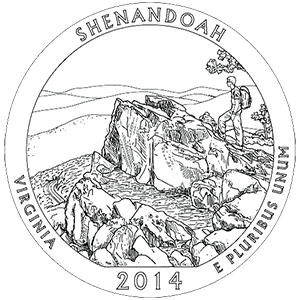
2014 · United States Mint image Official Mint coloring-page line drawing; reverse design by Phebe Hemphill. Design and artist source ↗
United States Mint quarter design · United States Mint. Open source ↗
- Quarter issue year
- 2014
- Retrieved
- 2026-10-30
- Image rights
- Image rights and source ↗
- Evidence
- Single source; not independently corroborated.
- Reuse
- Reverse designed by a Mint staff artist. Coloring-page graphic rights and any underlying third-party rights are not separately established. Do not imply Mint endorsement.
- Rights
- Reverse designed by a Mint staff artist. Coloring-page graphic rights and any underlying third-party rights are not separately established. Do not imply Mint endorsement.
Beldor Hollow Overlook · NPS | Aidan Walker. Open source ↗
- Information date
- Not supplied by the source
- Retrieved
- 2026-10-30
- Catalog image date
- 10/28/2026
- Source scope
- Shenandoah National Park
- Evidence
- Single source; not independently corroborated.
- Reuse
- Public domain:Full Granting Rights
- Rights
- Public domain:Full Granting Rights
Designation · National Park System directory. Open source ↗
- Information date
- Not supplied by the source
- Retrieved
- 2026-10-30
- Evidence
- Single source; not independently corroborated.
- Reuse
- Factual reference data; source attribution retained.
State or territory · National Park System directory. Open source ↗
- Information date
- Not supplied by the source
- Retrieved
- 2026-10-30
- Evidence
- Single source; not independently corroborated.
- Reuse
- Factual reference data; source attribution retained.
Park Map - Shenandoah National Park · National Park Service, Harpers Ferry Center. Open source ↗
- Information date
- Not supplied by the source
- Retrieved
- 2026-10-30
- Source scope
- Shenandoah National Park
- Download
- Official map PDF ↗
- Evidence
- Single source; not independently corroborated.
- Reuse
- Public domain; NPS map
- Rights
- Public domain; NPS map
People · People — National Park Service. Open source ↗
- Information date
- Not supplied by the source
- Retrieved
- 2026-10-30
- Source page last updated
- December 8, 2022
- Evidence
- Single source; not independently corroborated.
- Reuse
- NPS-authored U.S. government material is generally public domain; third-party content may have separate rights.
Places · Places — National Park Service. Open source ↗
- Information date
- Not supplied by the source
- Retrieved
- 2026-10-30
- Source page last updated
- December 20, 2022
- Evidence
- Single source; not independently corroborated.
- Reuse
- NPS-authored U.S. government material is generally public domain; third-party content may have separate rights.
Civilian Conservation Corps (CCC) · Civilian Conservation Corps (CCC) — National Park Service. Open source ↗
- Information date
- Not supplied by the source
- Retrieved
- 2026-10-30
- Source page last updated
- October 31, 2018
- Evidence
- Single source; not independently corroborated.
- Reuse
- NPS-authored U.S. government material is generally public domain; third-party content may have separate rights.
Skyland · Skyland — National Park Service. Open source ↗
- Information date
- Not supplied by the source
- Retrieved
- 2026-10-30
- Source page last updated
- March 31, 2026
- Evidence
- Single source; not independently corroborated.
- Reuse
- NPS-authored U.S. government material is generally public domain; third-party content may have separate rights.
History & Culture · National Park Service. Open source ↗
- Information date
- Not supplied by the source
- Retrieved
- 2026-10-30
- Evidence
- Single source; not independently corroborated.
- Reuse
- NPS-authored U.S. government material is generally public domain; third-party material may have separate rights. No images copied.
Ecology; Nature · Nature — National Park Service. Open source ↗
- Information date
- February 4, 2022
- Retrieved
- 2026-10-30
- Evidence
- Single source; not independently corroborated.
- Reuse
- NPS webpage text; U.S. government work generally public domain. Third-party material may have separate rights.
Birds · Birds — National Park Service. Open source ↗
- Information date
- April 22, 2026
- Retrieved
- 2026-10-30
- Evidence
- Single source; not independently corroborated.
- Reuse
- NPS webpage text; U.S. government work generally public domain. Third-party material may have separate rights.
Plants · Plants — National Park Service. Open source ↗
- Information date
- December 21, 2022
- Retrieved
- 2026-10-30
- Evidence
- Single source; not independently corroborated.
- Reuse
- NPS webpage text; U.S. government work generally public domain. Third-party material may have separate rights.
Animals · Animals — National Park Service. Open source ↗
- Information date
- December 5, 2023
- Retrieved
- 2026-10-30
- Evidence
- Single source; not independently corroborated.
- Reuse
- NPS webpage text; U.S. government work generally public domain. Third-party material may have separate rights.
Ecosystems · Ecosystems — National Park Service. Open source ↗
- Information date
- December 7, 2017
- Retrieved
- 2026-10-30
- Evidence
- Single source; not independently corroborated.
- Reuse
- NPS webpage text; U.S. government work generally public domain. Third-party material may have separate rights.
Environmental Factors · Environmental Factors — National Park Service. Open source ↗
- Information date
- April 22, 2021
- Retrieved
- 2026-10-30
- Evidence
- Single source; not independently corroborated.
- Reuse
- NPS webpage text; U.S. government work generally public domain. Third-party material may have separate rights.
Mammals · Mammals — National Park Service. Open source ↗
- Information date
- March 27, 2024
- Retrieved
- 2026-10-30
- Evidence
- Single source; not independently corroborated.
- Reuse
- NPS webpage text; U.S. government work generally public domain. Third-party material may have separate rights.
Mathews Arm Campground · National Park Service park structured data. Open source ↗
- Information date
- Not supplied by the source
- Retrieved
- 2026-10-30
- Evidence
- Single source; not independently corroborated.
- Reuse
- NPS-supplied text; NPS-authored U.S. government work is generally public domain, subject to third-party rights.
Big Meadows Campground · National Park Service park structured data. Open source ↗
- Information date
- Not supplied by the source
- Retrieved
- 2026-10-30
- Evidence
- Single source; not independently corroborated.
- Reuse
- NPS-supplied text; NPS-authored U.S. government work is generally public domain, subject to third-party rights.
Lewis Mountain Campground · National Park Service park structured data. Open source ↗
- Information date
- Not supplied by the source
- Retrieved
- 2026-10-30
- Evidence
- Single source; not independently corroborated.
- Reuse
- NPS-supplied text; NPS-authored U.S. government work is generally public domain, subject to third-party rights.
Loft Mountain Campground · National Park Service park structured data. Open source ↗
- Information date
- Not supplied by the source
- Retrieved
- 2026-10-30
- Evidence
- Single source; not independently corroborated.
- Reuse
- NPS-supplied text; NPS-authored U.S. government work is generally public domain, subject to third-party rights.
Camp · National Park Service. Open source ↗
- Information date
- Not supplied by the source
- Retrieved
- 2026-10-30
- Evidence
- Single source; not independently corroborated.
- Reuse
- NPS-supplied text; NPS-authored U.S. government work is generally public domain, subject to third-party rights.
Hiking · National Park Service. Open source ↗
- Information date
- Not supplied by the source
- Retrieved
- 2026-10-30
- Evidence
- Single source; not independently corroborated.
- Reuse
- NPS-supplied text; NPS-authored U.S. government work is generally public domain, subject to third-party rights.
Physical Address · Official park structured information. Open source ↗
- Information date
- Not supplied by the source
- Retrieved
- 2026-10-30
- Evidence
- Single source; not independently corroborated.
- Reuse
- NPS-supplied text; NPS-authored government work generally public domain, subject to third-party rights.
Mailing Address · Official park structured information. Open source ↗
- Information date
- Not supplied by the source
- Retrieved
- 2026-10-30
- Evidence
- Single source; not independently corroborated.
- Reuse
- NPS-supplied text; NPS-authored government work generally public domain, subject to third-party rights.
Telephone · Official park structured information. Open source ↗
- Information date
- Not supplied by the source
- Retrieved
- 2026-10-30
- Evidence
- Single source; not independently corroborated.
- Reuse
- NPS-supplied text; NPS-authored government work generally public domain, subject to third-party rights.
Recreation visits · National Park Service Visitor Use Statistics. Open source ↗
- Information date
- 2025
- Retrieved
- 2026-10-30
- Methodology
- NPS reporting unit; annual total is the sum of 12 monthly recreation visit estimates.
- Reporting unit
- Shenandoah NP
- Evidence
- Single source; not independently corroborated.
- Reuse
- Factual reference data; source attribution retained.
