National Parks · Arkansas
Hot Springs National Park
National Park Service source material · single source. Source dates and reuse information are available beside each field.
Check the official park website for current access, conditions and visitor information.
Introduction
Background: 1
Hot Springs National Park has a rich cultural past. The grand architecture of our historic bathhouses is equally matched by the natural curiosities that have been drawing people here for hundreds of years. Ancient thermal springs, mountain views, incredible geology, forested hikes, and abundant creeks – all in the middle of town – make Hot Springs National Park a unique and beautiful destination.
Geography
Designation: 4
National Park
State or territory: 5
Arkansas
Park Map - Hot Springs National Park: 6
Map scope: Hot Springs National Park
Map of Hot Springs National Park in Arkansas. The irregularly-shaped green area of the park stretches across the otherwise opalescent-white region from the bottom left to the top right corners of the map.
History and culture
People: 7
Humans have been coming to this area for thousands of years to quarry the Novaculite stone found on the hilltops and to partake of the hot and cold spring water flowing from the ground. Europeans first came to stay beginning in the early 1800s, mostly to soak in the supposedly healing geothermal waters coming out of Hot Springs Mountain. Others came later to work in the bathhouses or in nearby businesses associated with the bathing industry.
Explore this section to learn more about the people involved in the history of Hot Springs National Park. You can also read and hear stories about the men and women who worked in the bathhouses as employees , bringing the national park's thermal waters to millions of visitors. Read about the roles of African Americans in the bathing industry . These are excerpts from an interactive kiosk program at the park visitor center.
Places: 8
Hot Springs National Park is a 5,500-acre area that preserves geothermal spring water and resources related to therapeutic bathing. The park also provides opportunities for public health and wellness activities, and preserves and protects many historic structures, cultural landscapes, and natural settings. The Park itself is deeply historic, with lots of places to explore. From Arlington Lawn to Whittington Park, adventures await you.
Collections: 9
The collections at Hot Springs National Park include a wide variety of natural history specimens and cultural artifacts. Our natural history collection includes mammal and bird specimens, a small herbarium featuring species of plants that occur in the park, paleontological and geological specimens, mounted insects, and associated documents and reports.
The cultural collections include prehistoric and historic archeological materials and associated field records, historic artifacts associated with the bathing industry and the early exploration and settlement of the Hot Springs area, architectural objects related to existing and earlier bath houses, artwork, and extensive archival collections. The archives includes bathhouse records, oral histories, photographs, slides, postcards, drawings, maps, and park administrative records.
You may browse a small sampling of our thousands of collection items on the NPS Museum Management Program's NPS Web Catalog .
Archeology: 10
You may have heard that there have been people in Hot Springs National Park for over 10,000 years. But how do we know that without written documentation? The answer is archeology! Archeologists look at all of the different things people leave behind to help understand the mysteries of the past.
At Hot Springs National Park, we have a dense, rich archeological record with 92 sites and counting. We manage a huge variety of sites, including prehistoric novaculite quarries where Native Americans mined raw material for stone tools, the remains of hotels and bathhouses from the 1800s, historic dumps, prehistoric campsites, cemeteries, and much, much, more. We work with the Midwest Archeological Center, the state of Arkansas, the Absentee Shawnee Tribe, the Caddo Nation, the Osage Nation, and the Quapaw Tribe to identify, interpret, and protect all of these archeological sites.
Archeologists use TONS of different methods to help identify and understand sites, not just digging! For our first step, we need to know the site is there. Sometimes we can see buildings or quarries in satellite images or LiDAR (light detection and ranging) imagery, but most of the time site identification starts with a survey. This can be done either by walking through a designated area in straight lines or digging a series of holes in a grid pattern. Once we know something is there, we meticulously record what we can see. If nothing is on the surface, we might bring in equipment to perform a geophysical survey, like ground penetrating radar, that lets us see what is under the surface without disturbing anything. We also might dig test units, or square holes that give us a snapshot of what is happening underground. If necessary, we carefully excavate more of the site.
Regardless of what method we are using, we look at every possible type of evidence we can think of. Small changes in the soil can show us post holes or hearths. Types of artifacts or features found may tell us how the site was used. The raw materials used to make those artifacts may help us to learn about trade routes or migration. The list could go on all day! A grinding stone, for example, not only tells us that people were living here, it also suggests that the people who were living here probably lived here for long periods of time- no one wants to carry a big rock around! Archeologists take all of those puzzle pieces and put them together to get a better picture of the site and its role in the bigger context of history. A single artifact can change the way we understand the whole site- that is one of the many reasons it is important to take nothing but memories from the park.
If you find an artifact or archeological site in the park, the most important thing to do it leave it where it is! If possible, take a GPS point and a photograph and tell a ranger. It is against the law to take artifacts or damage an archeological site in any way.
Bathhouse Row Today: 11
The Bathhouse Row you see today consists of eight bathhouse buildings that were constructed between the years of 1892 and 1923. This is the largest collection of early 20th century bathhouses remaining in the United States. This area, along with the Grand Promenade, was designated as a National Historic Landmark District in 1987.
Choose one of the bathhouse names below to read more about that structure. The buildings are listed from south to north along the Row.
Bathhouse Attendants: 12
Millions of visitors have come to Hot Springs National Park to enjoy the natural thermal waters for their health as well as their pleasure. But how did one "take the waters"? Bathhouse attendants assisted patients and patrons during their time in the bathhouses.These men and women gained specific knowledge and invaluable skills in order to provide visitors everything Hot Springs National Park had to offer.
Bathhouse attendants bathed visitors and performed hydrotherapy treatments prescribed by a physician who was licensed by the Department of the Interior. They worked long hours in hot and humid conditions in the bathhouse. Services in the bathhouses expanded and diversified throughout the twentieth century with roles like attendant assistants (known as a helpers), pack room employees, and massage therapists populating Hot Springs' busy bathhouses. For most of Hot Springs' history, many of these men and women were African American. These men and women were well-trained and highly respected in the bathhouses and within their community.
Timothy L. Bottoms: 13
Dr. Timothy Leroy Bottoms (1917-2003) was the Chiropodist, or foot-health specialist, on the staff of the Fordyce Bathhouse in the late 1950s. He was born in Monticello, Arkansas, and later moved with his parents to Hot Springs where he graduated from Langston High School in 1939. Following graduation he was inducted into the U.S. Army, and was stationed in Italy, Africa, France, and Germany. At the end of World War II, he was selected by the Army to study cultural relations between America and Europe at the University of Dijon in France.
After being discharged from service Bottoms attended Lincoln University in Jefferson City, Missouri, where he majored in Pre-Medicine. He subsequently completed Podiatry School at the Illinois College of Podiatry and Foot Surgery in 1956. By 1957, he was listed in the city directory as the chiropodist in the Fordyce. A few years later he opened an office at 413 Malvern Avenue in the African American business district. Former clients relate that Dr. Bottoms would often sing as he worked on their feet. He remained in Hot Springs until his retirement in 1980.
James A. Cary: 14
Hot Springs National Park Ranger James Alexander Cary, a World War I veteran who joined the National Park Service in 1923, was murdered by bootleggers on March 12, 1927 while patrolling on West Mountain. He thereby became the first National Park Service Ranger to be killed in the line of duty.
Cary was born in Missouri on 19 December 1895 and served in the U.S. Navy during World War I. He began his federal service in Hot Springs at the U.S. Post Office in April 1919 and worked there until the end of March 1920. Cary then worked at the Army & Navy General Hospital from July 1921 to mid-January 1923. In October 1923 Cary received his appointment to Hot Springs National Park as a law enforcement ranger. He was paid $1,000 per year with a bonus of $250. Five people were arrested for Ranger Cary's murder, but no one was convicted of the crime. Cary left behind a young widow and two small children .
Samuel W. Fordyce: 15
Businessman and railroad magnate Samuel Wesley Fordyce (1840-1919) was a key figure in the early development and promotion of Hot Springs as an international spa and resort. He first visited town in 1873 seeking a cure for lingering health problems caused by wounds received while serving in the Civil War. Fordyce was so impressed with the healing thermal waters that he moved his family here to live in 1876.
Fordyce saw the potential of Hot Springs as a world-class health resort and proceeded to do all he could to develop the place and promote the curative powers of its thermal water. He invested heavily in the infrastructure of Hot Springs, partnering in the construction of several large hotels, the city opera house, all municipal utility systems, the street railway system, the local country club, and several bathhouses. He opened the opulent Fordyce Bathhouse in 1915, which today serves as the Visitor Center for Hot Springs National Park.
Benjamin F. Kelley: 16
Benjamin Franklin Kelley (1807-1891) was the first superintendent of Hot Springs Reservation, arriving in the park in October 1877. He was a retired brigadier general from the Union army who served during the Civil War and afterward had worked as an internal revenue collector for ten years.
Kelley’s first assignment in Hot Springs was to remove the hundreds of people that had set up camp on Hot Springs Mountain ’s western slope, surrounding the various thermal springs. The new encampment established further south on the mountain was called “Kelleytown.” General Kelley also established the first park headquarters and office building on Fountain Street and created plans for the first thermal water reservoirs designed to supply the growing number of bathhouses in the park. He retired due to poor health in December 1882.
Donald S. Libbey: 17
Donald Smith Libbey (1892-1959) served as Superintendent of Hot Springs National Park three times. During his first administration from 1936 to 1938 he welcomed President Franklin D. Roosevelt to the park while on a cross-country tour. Libbey also advocated for the expansion of park boundaries in order to provide more recreational outlets for visitors. He also pushed for the completion of the Grand Promenade and the creation of an outdoor amphitheater for public educational programs.
During Libbey’s second administration from 1944 to 1946 he oversaw wartime operations in the park. He also recommended the removal of overhead powerlines along Bathhouse Row in order to improve the cultural landscape and better protect the famous Magnolia trees along the street. During this time the park also took possession of Camp Garraday, the indigent medical facility near the campground operated by the US Public Health Service.
During Libbey’s third administration from 1951 to 1959 he dealt with several boundary encroachment issues and he created a detailed outline for the managed development of the park to meet visitor needs in the future. Libbey also advocated converting the former government bathhouse into a physical therapy center. The re-purposed facility opened in 1953 and was subsequently renamed in Libbey’s honor following his sudden death in September 1959.
William G. Maurice: 18
St. Louis native William Gilbert Maurice (1859-1927) first came to Hot Springs in 1870, but didn't establish a permanent home here until 1890. He and his father became partners in the Independent Bathhouse in 1892, eventually remodeling it and renaming it the Maurice Bathhouse. That building was torn down and replaced with the existing Maurice structure, which opened in 1912.
William Maurice and Samuel Fordyce competed with each other to offer the public the most modern and opulent bathing facility. When the new Maurice house opened it offered a solarium on the third floor, several gymnasiums, and staterooms where guests could rest after their baths. Fordyce delayed the construction of his new bathhouse until the Maurice opened, so he could alter his designs to better his competitor. After the Fordyce opened in 1915, Maurice immediately closed his bathhouse for an upgrade, which included a new sun porch along the front of the building, four large skylights, and hand-painted wall canvases. The third-floor solarium became the cozy Roycroft Den, with stained glass ceiling and colorful wall murals.
Robert R. Stevens: 19
Robert Radcliff Stevens (1855-1931) was the career United States Army officer in charge of overall improvement of the Hot Springs Reservation in the early-1890s. Over a five-year period he planned and oversaw construction of a suite of enhancements, including the formal entrance and balustrade, all walkways and roads on Hot Springs Mountain, the park-like front lawns and shady Magnolia Promenade that shaped what we know today as "Bathhouse Row," and Whittington Lake Park in the valley between West Mountain and Sugarloaf Mountain.
Stevens graduated from the U.S. Military Academy at West Point in 1877 and served at several posts in the western United States before being assigned to the Quartermaster Office at the Army and Navy General Hospital in Hot Springs in 1889. After leaving Hot Springs he was in charge of construction of Fort Logan H. Roots in North Little Rock. Later, he was assigned to oversee improvements at Yellowstone and Yosemite, as well as the expansion of Fort Sam Houston in San Antonio. He also served as Quartermaster at the Presidio in San Francisco and fought in the Philippine-American War.
Hot Springs Mountain Tower: 20
In 1877 local mill owner Enoch Woolman built a wooden observation tower at the summit of Hot Springs Mountain to allow visitors to enjoy the view of the surrounding region. In 1906 a new steel tower opened on Hot Springs Mountain on land leased by Charles N. Rix, president of Arkansas National Bank, and the old Woolman Observatory was removed. Rix Tower included an elevator to carry visitors to the top, where they could view an area estimated by Superintendent Scott Smith to cover a radius of 30 to 40 miles. Rix Tower was taken down on July 13, 1971 and in March 1982 a contract was signed for the construction of a new observation tower. The 216-foot tall structure opened to the public in June 1983 as part of the 13th Annual Arkansas Fun Festival.
The Hot Springs Mountain Tower is operated as a concession for the park. The tower's upper observation deck is open-air and at an elevation of 1,256 feet above sea level. From there, visitors may overlook 140 square miles of surrounding countryside, including the entire park and a portion of the Ouachita Mountains. The lower observation deck, enclosed and air conditioned, contains exhibits highlighting park and local history. A gift shop is located at the base of the tower. Visit the Mountain Tower's offical website for operating hours, fees, and other information.
History & Culture: 21
Hot Springs National Park has a long and colorful history, beginning long before its designation as Hot Springs Reservation in 1832. American Indians came here for thousands of years to quarry novaculite for their tools and weapons. The Dunbar-Hunter Expedition came here in 1804, sent by President Thomas Jefferson to explore the southern reaches of the Louisiana Purchase. Soon a bustling town grew up around the hot springs to provide services for health seekers. The resultant bathing industry led to Hot Springs becoming known as the "Great American Spa."
The area now known as "Hot Springs National Park" first became United States territory in 1803 as part of the Louisiana Purchase. The first permanent settlers to reach the Hot Springs area in 1807 were quick to realize the springs' potential as a health resort. By the 1830s, log cabins and a store had been built to meet the needs (albeit in a rudimentary way) of visitors to the springs.
To protect this unique national resource and preserve it for the use of the public, the Arkansas Territorial Legislature had requested in 1820 that the springs and adjoining mountains be set aside as a federal reservation (not to be confused with the Indian reservations being established around the same time). On April 20, 1832, President Andrew Jackson signed legislation to set aside "...four sections of land including said (hot) springs, reserved for the future disposal of the United States (which) shall not be entered, located, or appropriated, for any other purpose whatsoever." This makes Hot Springs National Park the oldest national park among current National Park units, predating Yellowstone National Park by forty years.
Unfortunately, Congress failed to pass any legislation for administering the site. As a result, no controls were exerted in the area, and people continued to settle there, building businesses around and over the springs.
Just as Hot Springs Reservation was reestablished as government property, a devastating fire swept up the valley, destroying most of the south and central downtown area but leaving the Arlington and Grand Central Hotels, the Hale, Rector, and Big Iron Bathhouses, and the buildings to their north. The structures were in general rough, utilitarian, and in poor repair. Many townspeople considered the great fire of 1878 to be more a blessing than a tragedy, since it cleared the way for new construction that was more substantial and attractive. In the short period after the fire, the government established stringent standards for bathhouse construction, and the area rapidly changed from a rough frontier town to an elegant spa city. Building, landscaping, and engineering projects proceeded apace.
In 1882-83 the government enclosed Hot Springs creek in an underground arch for flood and sewerage control. The area above the arch was landscaped and bounded with Lombardy poplars. The new Victorian bathhouses built between 1880 and 1888 were larger and more luxurious than could have been dreamed of ten years earlier. The wooden troughs carrying the thermal water down the mountainside were replaced with underground pipes. Government-operated facilities on the slopes of Hot Springs Mountain expanded access to the thermal waters. The Army-Navy General Hospital offered medical care to active duty, and occassionally veteran, soldiers. The government bathhouse, sometimes called the government free bathhouse, provided free bathing facilities to health seekers who could not afford the cost of the pay bathhouses. The Secretary of the Interior appointed U.S. Army Captain John R. Stevens to oversee a number of ambitious landscaping and building projects in the 1890s. The resulting improvements included a formal entrance, mountain drives, a lake park on Whittington Avenue, fountains, and a brick bathhouse for the indigent. By 1901 all of the springs had been walled up and covered to protect them. Between 1912 and 1923 the wooden Victorian bathhouses built in the 1880s were gradually replaced with fire-resistant brick and stucco bathhouses, several of which featured marble walls, billiard rooms, gymnasiums, and stained glass windows. The final metamorphosis of Bathhouse Row was completed when the Lamar Bathhouse opened its doors for business in 1923. The bathhouses, all of which are still standing today, ushered in a new age of spa luxury.
On August 25, 1916, Congress established the National Park Service (39 Stat. 535), and Hot Springs Reservation came under its administration. Stephen T. Mather, head of the new organization, took a serious interest in the development of the site. His enthusiasm for Hot Springs apparently led to its designation as the eighteenth national park on March 4, 1921 (41 Stat. 1407).At the same time, the townspeople decided to call their city Hot Springs National Park as well. The designation of the reservation as a national park ushered in the final phase of construction culminating in the Bathhouse Row of today. In 1922 the old government bathhouse was demolished, and a new state-of-the-art bathhouse opened on Reserve and Spring Streets. In 1933 a central thermal water collection and distribution system was completed, and grading began on the Grand Promenade behind Bathhouse Row. In 1936 the new administration building on the corner of Reserve and Central opened, replacing the park headquarters earlier converted from the reservation’s pump house. The Imperial Bathhouse next to the administration building was razed in 1937 to make way for the Grand Promenade entrance on Reserve, although it was to be 1958 before this ambitious project was completely finished. In the final phase of construction, the Fountain Street superintendent’s residence was razed, and the promenade was extended to Fountain Street.
By the 1960s the bathing industry in the park and in the city had declined considerably. On Bathhouse Row, the eight grand bathhouses that had been thriving since their construction in the first three decades of the century suffered from the decline. The elegant Fordyce Bathhouse was the first to close, in 1962, followed by the Maurice, the Ozark, and the Hale in the 1970s. In 1984 the Quapaw (briefly reincarnated as Health Services, Inc.) and the Superior closed. When the Lamar closed in 1985, it left only the Buckstaff still operating on Bathhouse Row. Bathhouse Row and its environs were placed on the National Register of Historic Places on November 13, 1974. The desire to revitalize Bathhouse Row also led citizens to campaign for adaptive uses of the vacant buildings. The strongest concern was to save the most elegant bathhouse, the Fordyce, which was consequently adapted for use as a visitor center and museum. Today, nearly all the bathhouses have been renovated and adapted for modern use.
Arlington Lawn: 22
Arlington Lawn gets its name from the fact that the first two versions of the luxury hotel now located north of the park across Fountain Street were located here on government property. The first, a 150-room wooden structure completed in 1875, was designed specifically to offer patrons the most modern, first-class accommodations possible, the same as they would expect in New York or Chicago. It was replaced in 1893 by a larger, more elaborate brick, stone, and iron version. The grand hotel was of Moorish and Spanish Renaissance style and featured a glass-topped rotunda, large ballroom, and bridges onto Hot Springs Mountain from several floors. It offered 300 guest rooms, 50 of which had private bathrooms. The 2nd Arlington burned in 1923 and was replaced in 1925 by the iconic 500-room Arlington Hotel still in use today.
Stonebridge Area: 23
The Stonebridge Area contains several features of the old Fordyce-Ricks estate. In 1878 Samuel W. Fordyce purchased about 1,200 acres on Park Avenue northeast of the city. Later, in 1903 he hired the St. Louis architectural firm of Mauran, Russell, and Garden to design a log house on the property reminiscent of a late 19th or early 20th century railroad hostelry. Construction on the imposing 4,338-square-foot home began in 1904 and was completed by 1909. "The Cabin," as Fordyce called it, was designed in the rustic Adirondack style with an exterior of logs and stone designed to integrate with the surrounding environment. Fordyce decorated the interior of "the Cabin" with his weapons collection and trophies of the hunt. John Fordyce, the eldest of Samuel’s three sons, served as construction engineer on the project. John Fordyce inherited the property upon his father's death and added a dam on the creek below the house to form a pond for his wife to enjoy. Named Lake Lillian in her honor, Fordyce also constructed large and small stone bridges over the creek and pond, a boathouse, and a water wheel to generate electricity for the house. After donating and selling some of land to the National Park Service, John Fordyce sold the remaining acreage of the original estate in 1937 to Major General Earl T. Ricks. The house and 17 acres on the hilltop above the pond are still privately owned. Today, Lake Lillian is known locally as Ricks Pond.
Whittington Park: 24
Originally called Whittington Lake Reserve when it was built in the late 1890s, this tree-shaded greenway is located along Whittington Creek between West Mountain and Sugarloaf Mountain. It was named for early Hot Springs resident and businessman Hiram A. Whittington.
Whittington Park once featured two shallow rowing lakes, several pavilions, tennis courts, carriage drives, and a caretaker's house. Today, it simply offers shaded walking trails for visitors to enjoy.
Lamar Bathhouse: 25
Today, the structure houses offices for the park's Resources Management employees, the park archives, museum collection storage spaces, a small research library, and the park store, Bathhouse Row Emporium , operated by America's National Parks. The Lamar Bathhouse is open every day from 9:00-5:00pm, with the exception of Thanksgiving Day, Christmas Day, and New Years Day when it is closed.
The current Lamar Bathhouse opened on April 16, 1923 replacing a wooden Victorian structure named in honor of the former U. S. Supreme Court Justice Lucius Quintus Cincinnatus Lamar. He was Secretary of the Interior when the first version of the bathhouse was built in 1888. The stone, brick, and stucco construction is moderately Spanish in flavor and coordinates well with the five other bathhouses with Spanish motifs. The Lamar was unique in that it offered a range of tub lengths (5', 5' 6", 5' 9", 6', 6' 6") for people of various heights. It also had a small coed gymnasium with another separate area for women adjacent to the gymnasium. The Lamar Bathhouse closed on November 30, 1985.
The present structure cost $130,000 to build. Harry Schwebke’s architectural design for the Lamar can be described as representing “a transitional style often used in clean-lined commercial buildings of the time that were still not totally devoid of elements left over from various classical revivals.” The most distinctive exterior component is the sun porch with its windows of three sections and a wide center bay. The lobby, featuring a long counter of Tennessee marble, was the largest of the eight bathhouses on the Row. Murals and stenciling were added to the lobby and stairways sometime in the 1920s by Danish muralist J. W. Zelm for a European aura. In the mid-1940's, the interior halls and stairs were embellished with marble, ornamental iron balustrades, and silver glass interspersed with red panel wainscots.
Buckstaff Bathhouse: 26
The Buckstaff is the only bathhouse that offers a traditional bathing experience and has been in continuous operation since opening its doors in 1912. Visit the Buckstaff Baths website to learn more about taking a bath. The Buckstaff is open every day from 8:00am - 3:00pm, unless otherwise noted.
The Buckstaff Bathhouse, named for controlling shareholders George and Milo Buckstaff, replaced the former Rammelsberg Bathhouse, a brick Victorian structure. The Rammelsberg replaced the A. B. Gaines bathhouse destroyed in the 1878 fire, but evidently there was a brick bathhouse on the site in the late 1850s as well. Designed by Frank W. Gibb and Company, Architects, the Buckstaff cost $125,000 to build and contains 27,000 square feet on three main floors. Because it has been in continuous operation since it opened on February 1, 1912 it is one of the best preserved of all of the bathhouses on Bathhouse Row. However, it has undergone many changes over the years. Originally it had a large hydrotherapeutic department, which only it, the Fordyce, and the Imperial offered.
Classical in design, with imposing Doric columns and urns gracing the front of the building, the Buckstaff features taupe brick with white stucco and wood trim. It epitomizes the Edwardian style of classically designed buildings popular during the first decade of the 20th century. Colorado marble is used throughout the interior, particularly in the bath halls. The floors are of white and colored hexagonal tile in varying patterns. All levels may be accessed by way of stairs or the building’s original elevator, with an ornate interior reminiscent of the Golden Age of Bathing. The current capacity of the building is 1,000 bathers per day.
Ozark Bathhouse: 27
Until the Fall of 2024, the Ozark housed the Hot Springs National Park Cultural Center. The Center featured gallery spaces for displaying artwork from the park's Artist-in-Residence Program and other temporary exhibitions. In Summer of 2025, the Mystic Ozark took over the bathhouse space, offering immersive, interactive exhibits about the waters and legends of Hot Springs.
Designed by architects Mann and Stern of Little Rock, the bathhouse was completed in the summer of 1922, just a few months after the Quapaw opened for business. The owners rejected three earlier Mann and Stern designs considered too grand and expensive. Built at a cost of $93,000 in the Spanish Colonial Revival style, the building is set between low towers whose receding windows suggest the nascent Art Deco movement. The prominence of the towers was lessened during the 1942 renovation that brought the building’s wings forward in line with the front porch, which was enclosed at the same time. The plaster-cast window boxes are unique on Bathhouse Row. The cartouches on both sides of the front are of the scroll and shield type with the center symbol described as The Tree of Health or The Tree of Life. Like the Quapaw, the Ozark was more impressive in its exterior facade than in its interior appointments, with only 14,000 square feet and twenty-seven tubs. It catered to a middle economic class of bathers unwilling to pay for frills. The Ozark closed in 1977. The painted wooden porch enclosure was removed in the late 1990s to return the building to its original appearance.
Quapaw Bathhouse: 28
The Quapaw Bathhouse is one of two locations where visitors can soak in the thermal springs. Quapaw offers private baths, public pools, and modern day spa services.The Quapaw is open every day, except Tuesday, from 10:00am - 6:00pm. Visit the Quapaw Baths website for more information.
The Quapaw Bathhouse opened in 1922. It is the longest building on Bathhouse Row, occupying the site of two previous bathhouses, the Horseshoe and Magnesia. Vacant since closing in 1984, it was the first to be leased for adaptive reuse. It reopened as a family-oriented spa in late June 2008.
Fordyce Bathhouse: 29
The Fordyce Bathhouse today functions as the park’s visitor center. You can talk with a park ranger, gather more information about the Park and local area, or join a ranger program. The Fordyce Bathhouse is open every day from 9:00-5:00pm, with the exception of Thanksgiving Day, Christmas Day, and New Years Day.
The Fordyce opened March 1, 1915. Designed by Little Rock architects Mann and Stern and constructed under the supervision of owner Sam Fordyce's son John, the building eventually cost over $212,000 to build, equip, and furnish. Totaling approximately 28,000 square feet, the Fordyce is the largest bathhouse on the Row. It has three main floors, two courtyards, and a basement under most of the building. The Fordyce became the first bathhouse on the Row to go out of business when it suspended operations on June 30, 1962, but it was extensively restored by 1989 and is now enjoying a renaissance as a historically furnished museum. Take a peek at some refurnished rooms.
Maurice Bathhouse: 30
The Maurice Bathhouse is the only unoccupied historic bathhouse remaining on Bathhouse Row and will soon become available for commercial leasing.
The Maurice Bathhouse first opened on January 1, 1912 to replace an existing Victorian-style building. The previous bathhouse had been known as the Independent before being renamed after previous owner Charles Maurice. With a total floor space of 23,000 square feet, the three-story bathhouse had ample room for a complete range of services and amenities, including a gymnasium, staterooms, a roof garden, and twin elevators. In the 1930s, a therapeutic pool was installed in the basement for the treatment of arthritis and polio. It was the only bathhouse on the Row to have a pool. During its six decades in the operation, over 2.5 million therapeutic baths were provided. The Maurice was the second bathhouse to close on Bathhouse Row, shutting its doors in November 1974.
Designed by architect George Gleim, Jr., of New York City, the Maurice Bathhouse was the first bathhouse fully modernized bathhouse in Hot Springs, incorporating the most state of the art heating, plumbing, and ventilation of the day. The building design is an eclectic combination of Italian Renaissance Revival and Mediterranean styles. The interior boasted a lobby lined with gilded oak pilasters and large stained glass skylights throughout the building. The new building boasted a capacity for 650 bathers-a-day. In 1915, Maurice hired architects George Mann and Eugene Stern to renovate the bathhouse. The remodel included the "Roycroft Den" named in honor of Elbert Hubbard, Maurice's friend as well as the founder of the Roycrofters craftsman design studio. The Craftsman style den included a stone hearth, an ornate stained glass ceiling, plaster features, and a handpainted frieze. The den was converted to a gymnasium in the 1930s as the Arts and Crafts movement faded in popularity.
Nature
Ecology: 31
The thermal springs are the primary natural resource of the park, but they have not been preserved in their unaltered state as natural surface phenomena. They have instead been managed to conserve the production of uncontaminated hot water for public use.
The mountains within the park are also managed within this conservation philosophy in order to preserve the hydrological system that feeds the springs. The park and its surrounding mountains exhibit a south-central United States pine-oak-hickory forest ecosystem. The park's vegetation, thermal waters, cold water springs, bathhouses and associated cultural features, foot trails, prehistoric and historic novaculite quarries, and general physiography combine to form an almost 5400 acre area of resource preservation and interpretation that is under the exclusive legislative jurisdiction of the federal government. Another 672.69 acres are within the park boundary but are not federally owned.
The city of Hot Springs, Arkansas, with an approximate population of 33,000, lies immediately outside the park and exerts a significant influence on it.
Hot Springs National Park has an abundance of flowers, shrugs, moss, lichens, vines, and trees. Learn more.
Learn about the geologic features, thermal springs, and natural features that make Hot Springs National Park unique.
Need a research permit? Want to learn more about what has been discovered about the Park? Look no further.
I&M builds a strong scientific foundation for the management and protection of natural resources in the Park. Learn more.
Birds: 32
Hot Springs National Park supports a variety of song birds, wild turkey, raptors and other birds. Birding is possible all year long, as the species often change with the spring and fall migrations. The Grand Promenade is great place to see many types of birds as it hosts both deciduous and evergreen trees and shrubs. The trails on West Mountain in the early morning are another wonderful place to see and hear a variety of birds. For all the birds that can be found in the park, please see the list below.
Each year, citizen scientists make an enormous contribution to conservation by braving the cold weather to take part in the Christmas Bird Count. Hot Springs National Park, along with the local chapters of the National Audubon Society and the City of Hot Springs, collects this data to assess the bird populations and to help guide conservation actions. Last year's count included over 9,000 birds from 113 separate species. In prior years, the Hot Springs National Park Bird Count has tied for the highest species diversity in the state! Having that sort of information for thousands of circles across the nation gives citizen science the spotlight in studies about bird populations, mirgration patterns, and even climate change impacts. From December 14 through January 5, all around the country families, students, birders and scientists - armed with binoculars, bird guides, and checklists - go out on an annual mission, often before dawn. For over one hundred years, the desire to both make a difference and to experience the beauty of nature has driven dedicated people to leave the comfort of a warm house during the Holiday season.
Plants: 33
Grasses are not only a food source for some animals, but they also play an important ecological role. Learn more about grasses in the Park.
Mosses and liverworts provide soil stabilization and help regulate soil moisture and temperature. Find out which species are in the Park.
The mountains surrounding Hot Springs National Park are covered with deciduous and evergreen trees and shrubs. Explore their world.
Animals: 34
Surrounded by the Ouachita National Forest and the City of Hot Springs, Hot Springs National Park is a critical sanctuary for a variety of animals. This oasis of dense forest on rocky mountain slopes with their novaculite outcrops and lush creek valleys make a perfect home for many different species. Prior to park expansion in the early twentieth century, over hunting, trapping, and loss of habitat caused the eradication of the gray wolf, the red wolf, and the bison in this area. Because of this reason it is vital for National Parks to protect and preserve its natural resources. Today, there are over 50 species of mammals protected in the park. The most common are the white-tailed deer, groundhog, chipmunk, and squirrel. There are also over 100 species of birds, 23 of which stay only temporarily, as they migrate from their breeding grounds in Canada and the northern United States to their wintering grounds along the southern coast of the United States and in Central and South America. The park has around 50 fish species, including the grass carp, bluegill, and banded darter. Because of the size of the shallow creeks and pond, the park cannot support the large game fish. The larger fish, like bass, uses these waterways for nesting and laying their eggs. These eggs will then hatch, and the fry (baby fish) will stay in the creeks until they move into larger bodies of water. There are more than 70 types of reptiles and amphibians. You can find many species of snakes, turtles, lizards, frogs, and salamanders in the park. Caution the park is home to five venomous snakes, including the copperhead snake that can be seen along most trails.
Viewing wildlife in the Hot Springs can be challenging because most of the park is covered by dense forest and within the boundaries of a city. Open trail areas offer some of the best opportunities to see animals like the white-tailed deer. Since many animals are most active at night, the best time to view wildlife occurs during early morning and evening hours. In the wintertime, wildlife is more visible because deciduous trees have lost their leaves. It's also a good idea to carry binoculars. And don't forget to scan the trees, many animals spend their days among the branches.
Parks provide a unique opportunity to view animals’ natural behavior in the wild. In general, if animals react to your presence, you are too close. Use binoculars or a zoom lens and move back if wildlife approach you. Let wildlife be wild and observe from a distance. Remember to treat wildlife with proper caution and respect.
Leaving wildlife alone can help your viewing experience—plus it’s the law. It’s illegal to feed, touch, tease, frighten, or intentionally disturb wildlife. Remember that wildlife in parks are not pets and can be unpredictable when they are disturbed or surprised. Interacting with wildlife also can cause harm to both people and wildlife.
Vehicle strikes are one of the deadliest types of encounters for wildlife in parks. Roads often cut through animal’s habitats or migration routes. Be sure to always follow the speed limits and watch for wildlife that may dart into the road.
To an animal, anything that smells like food is treated like food. Access to trash, even crumbs left on picnic tables can attract them. Once they have learned that people are a source of food, wildlife can become aggressive toward people. This puts you at risk of injury and the wildlife at risk of being removed or labeled a nuisance by wildlife managers.
Tell a ranger if you come into physical contact with wildlife. Also, tell a ranger if you see wildlife that are dead or acting strangely. This includes wildlife that approaches you. Leave “orphaned” animals alone. Young animals that appear alone typically have parents waiting nearby. And when you see people who aren’t following these guidelines, contact a ranger.
The safety of these animals, as well as your safety, depends on everyone using good judgment and by setting a good example. By following these simple guidelines, you can help protect Hot Springs National Parks wildlife. Learn even more ways to #RecreateResponsibly .
Mammals: 35
Hot Springs National Park , nestled in the heart of the Ouachita Mountains is home to a diverse range of mammalian inhabitants, which range from tiny chipmunks to 400lb black bears. The National Park Service is committed to preserving the natural resources these animals need to survive, through the protection and restoration of their native habitat. During your visit keep your eyes and ears open for the 49 different species of mammals recorded within the park.
All mammals are classified into the class Mammalia. Mammals—along with birds, fish, amphibians, and reptiles—belong to a large group known as the vertebrates (animals possessing a backbone). Mammals share common features with each other, including being homeothermic (constant internal body temperature), having hair, having mammary glands (milk-producing structures in females), and being able to give live birth. There are more than 5,000 different mammalian species in the world, with around 500 being found in North America. Of those, around seventy wild species reside in Arkansas, and roughly 49 can be found within the park. For a description of several of the most popular mammals in the park, visit this page.
Many of the small mammals in Arkansas belong to the orders Soricomorpha (shrews and moles), Chiroptera (bats), and Rodentia (squirrels, rats, mice). These mammals are an important part of the food chain and the ecosystem. Bats are the only group of mammals that are capable of true flight. They are usually seen at dusk, during the night, and at dawn when they are feeding on insects in the air. Bats can carry rabies, so they should not be handled by people. Bats benefit humans, however, by reducing the insect population. Did you know that Hot Springs National Park has a Junior Ranger Program just for bats? Visit us in the Fordyce Museum, or send us an email and ask for one! Other small mammals that can be found in the park include the bobcat, coyote ( Canis latrans ), gray fox, raccoon ( Procyon lotor ), red fox ( Vulpes vulpes ), striped skunk ( Mephitis mephitis ), and Virginia opossum ( Didelphis virginiana ).
While the state of Arkansas is home to several large mammal speices, Black bears ( Urus americanus ) and white tailed deer ( Odocoileus virginianus) are the two most common in the park. Even though it is not often that our guests will come into contact with a bear, we can often tell they are around by finding their scat along or around the trails. Remember to respect all wildlife that you encounter in the park and keep a safe distance away from them. If you have a wildlife sighting that you'd like to report, send us an email!
Connior, Mathew B., South Arkansas Community College. (2018). Mammals, Encyclopedia of Arkansas, Central Arkansas Library Systems. Retrieved from https://encyclopediaofarkansas.net/entries/mammals-5152/
Historic places and exhibits
Fordyce Bathhouse Visitor Center and Museum: 36
The Fordyce Bathhouse Visitor Center and Museum is open 7 days a week, 9a-5p, with the exception of Thanksgiving Day, Christmas Day, and New Years Day.
Trails and walks
Hiking: 37
Hot spring water running down from Hot Spring Mountain on Tufa Terrace Trail NPS Photo/Mitch Smith Walking paths have long been a part of Hot Springs National Park and the preceding Hot Springs Reservation. Today those walking paths form the base of the park’s trail system. There are two concentrated areas of hiking trails within the park, the Hot Springs and North Mountain Trails and the West Mountain Trails . Both of these areas are composed of relatively short, interconnected trails. The Sunset Trail is a longer trail that travels through more remote areas of the park. Maps Paper trail maps can be found at the Fordyce Bathhouse and Visitor Center. Digital maps with real-time GPS location are available by downloading the service-wide NPS App .
Hot Springs and North Mountain Trails The Hot Springs and North Mountain trails are popular since they are easy to reach and provide scenic views. You can get to these trails via Stephen’s Balustrade (grand staircase) behind the Fordyce Bathhouse, Hot Springs Mountain Drive, and the Gulpha Gorge Campground. See the Hot Springs and North Mountain trail map for more information. *Note: Oertel Trail is still labeled as Dead Chief Trail on the park's brochure. West Mountain Trails The West Mountain trails are less traveled, providing greater opportunities for wildlife sightings. You can get to these trails via Whittington Park and the Canyon Trailhead. See the West Mountain trail map for more information. Sunset Trail The Sunset Trail is the longest trail in Hot Springs National Park, covering approximately 10 miles one way or complete the 15-17 mile loop. It completes a circuit near the inner edge of the park boundary. Crossing all types of terrain, the trail makes its way through the most remote areas of the park. Due to the length of this trail, it is frequently broken up into three separate sections: West Mountain (2.8 miles), Sugarloaf Mountain (2.6 miles), and Stonebridge Road (3.8 miles). The Sunset Trail can be combined with Hot Springs Mountain trails, North Mountain trails, and West Mountain trails to complete a strenuous 15-17-mile loop hike. See the Sunset Trail map for more information.
Campgrounds
Gulpha Gorge Campground: 38
A map of Gulpha Gorge Campground Campground Overview Campsites at Gulpha Gorge Campground vary in size and can accommodate both tents and recreational vehicles (RV's). Site Amenities All sites have full hookups: 30 and 50 amp electric, water and sewer connections. Sites are not pull-through. Each campsite has a picnic table, pedestal grill, and water. There are modern restrooms. Onsite showers are accessible to campers using the door code provided in their reservation information. Maximum occupancy is limited to eight people/two vehicles (one RV and one tent OR two tents) per site. Check in time is at 2:00 pm, and check out time is 12:00 pm. Fees & Reservations All 40 campsites at Gulpha Gorge Campground will require prior reservation on www.Recreation.gov , and will cost $34 per night. Accessible campsites are made available a week in advance. To reserve beyond that timeframe, call the Fordyce Visitor Center (501-620-6715) for assistance. Limitations Camping in Gulpha Gorge Campground is limited to a total of 14 consecutive days and a cumulative total of 30 days in any calendar year. Each 14-day consecutive stay must be followed by a minimum of a 7-day break.
Learn about the various ways that you can experience the thermal springs in the Park.
With 26 miles of hiking trails in the Park, you can find great views, beautiful forest scenery, and feel like you're not in the City.
Learn about the natural resources at Hot Springs National Park. This includes information about our thermal water, wildlife, and plants.
Bathhouse Row is home to the Park's historic bathhouses. Learn about what is available in each of the bathhouses today.
Places to explore
Things To Do: 39
Hot Springs National Park has a rich cultural past. It stands as an icon for healing and a tribute to the “American Spa” of the 20th century. The grand architecture of our nine historic bathhouses is equally matched by the natural curiosities that have been drawing people here for hundreds of years. The ancient thermal springs, mountain views, incredible geology, forested hikes, and abundant creeks – all in the middle of town – make Hot Springs National Park a unique and beautiful destination. Be sure to come by the Fordyce Bathhouse Museum and Visitor Center to talk with a ranger and for a glimpse into the grandeur of this special place.
Watch our orientation video and plan your visit with the help of park rangers. We hope that you enjoy your time at Hot Springs National Park!
Explore There are many ways to explore Hot Springs National Park. These are a few of the most popular ways to experience the Park and make your visit memorable.
Learn Enrich your visit to Hot Springs by becoming a junior ranger, going on a guided tour, or participating in a ranger program.
Relax Looking for a quieter experience? Hot Springs offers ways to slow down and reconnect with yourself and nature.
Suggested Itineraries Need some ideas? Short on time? See our recommendations below. If you only have an hour: Tour the historic Fordyce Bathhouse Stroll along Bathhouse Row Observe the Display Springs and Hot Water Cascade If you have half a day: Do all of the above Join a park ranger for a guided tour Become a Junior Ranger Taste the water Stroll along the Grand Promenade Take a bath Hike or drive to the Hot Springs Mountain Tower Shop at the park store, Bathhouse Row Emporium Take a selfie at a memorable place in the park If you have all day or more: Do all of the above Hike some or all of the park's 26 miles of trails Drive the park's scenic mountain roads Picnic at one of the established picnic areas Quaff the elixir at the Superior Bathhouse Brewery View Artist-In-Residence artwork at the Ozark Bathhouse Camp at the Gulpha Gorge Campground Spend the night at the Hotel Hale
Be sure to come by the Fordyce Bathhouse Museum and Visitor Center to talk with a ranger and for a glimpse into the grandeur of this special place. Watch our orientation video and plan your visit with the help of park rangers.
Visitor information
Visitation
Sources & field notes
Source records (43)
Select a numbered reference to open a source card. Retrieval dates describe this edition’s source capture, rather than an independent verification or the date of the underlying information.
Background · Official park structured information. Open source ↗
- Information date
- Not supplied by the source
- Retrieved
- 2026-10-30
- Evidence
- Single source; not independently corroborated.
- Reuse
- NPS-supplied text; NPS-authored government work generally public domain, subject to third-party rights.
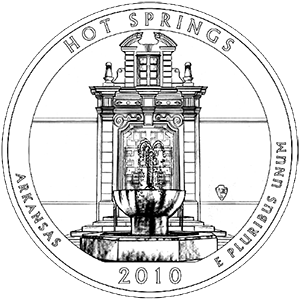
2010 · United States Mint image Official Mint coloring-page line drawing; reverse design by Don Everhart. Design and artist source ↗
United States Mint quarter design · United States Mint. Open source ↗
- Quarter issue year
- 2010
- Retrieved
- 2026-10-30
- Image rights
- Image rights and source ↗
- Evidence
- Single source; not independently corroborated.
- Reuse
- Reverse designed by a Mint staff artist. Coloring-page graphic rights and any underlying third-party rights are not separately established. Do not imply Mint endorsement.
- Rights
- Reverse designed by a Mint staff artist. Coloring-page graphic rights and any underlying third-party rights are not separately established. Do not imply Mint endorsement.
Bathhouse Row · National Park Service Picture – Courtesy of Hot Springs National Park Archives. Open source ↗
- Information date
- Not supplied by the source
- Retrieved
- 2026-10-30
- Source scope
- Hot Springs National Park
- Evidence
- Single source; not independently corroborated.
- Reuse
- Public domain:Full Granting Rights
- Rights
- Public domain:Full Granting Rights
Designation · National Park System directory. Open source ↗
- Information date
- Not supplied by the source
- Retrieved
- 2026-10-30
- Evidence
- Single source; not independently corroborated.
- Reuse
- Factual reference data; source attribution retained.
State or territory · National Park System directory. Open source ↗
- Information date
- Not supplied by the source
- Retrieved
- 2026-10-30
- Evidence
- Single source; not independently corroborated.
- Reuse
- Factual reference data; source attribution retained.
Park Map - Hot Springs National Park · National Park Service, Harpers Ferry Center. Open source ↗
- Information date
- Not supplied by the source
- Retrieved
- 2026-10-30
- Source scope
- Hot Springs National Park
- Download
- Official map PDF ↗
- Evidence
- Single source; not independently corroborated.
- Reuse
- Public domain; NPS map
- Rights
- Public domain; NPS map
People · People — National Park Service. Open source ↗
- Information date
- Not supplied by the source
- Retrieved
- 2026-10-30
- Source page last updated
- July 11, 2023
- Evidence
- Single source; not independently corroborated.
- Reuse
- NPS-authored U.S. government material is generally public domain; third-party content may have separate rights.
Places · Places — National Park Service. Open source ↗
- Information date
- Not supplied by the source
- Retrieved
- 2026-10-30
- Source page last updated
- April 15, 2021
- Evidence
- Single source; not independently corroborated.
- Reuse
- NPS-authored U.S. government material is generally public domain; third-party content may have separate rights.
Collections · Collections — National Park Service. Open source ↗
- Information date
- Not supplied by the source
- Retrieved
- 2026-10-30
- Source page last updated
- September 25, 2020
- Evidence
- Single source; not independently corroborated.
- Reuse
- NPS-authored U.S. government material is generally public domain; third-party content may have separate rights.
Archeology · Archeology — National Park Service. Open source ↗
- Information date
- Not supplied by the source
- Retrieved
- 2026-10-30
- Source page last updated
- April 23, 2024
- Evidence
- Single source; not independently corroborated.
- Reuse
- NPS-authored U.S. government material is generally public domain; third-party content may have separate rights.
Bathhouse Row Today · Bathhouse Row Today — National Park Service. Open source ↗
- Information date
- Not supplied by the source
- Retrieved
- 2026-10-30
- Source page last updated
- May 21, 2026
- Evidence
- Single source; not independently corroborated.
- Reuse
- NPS-authored U.S. government material is generally public domain; third-party content may have separate rights.
Bathhouse Attendants · Bathhouse Attendants — National Park Service. Open source ↗
- Information date
- Not supplied by the source
- Retrieved
- 2026-10-30
- Source page last updated
- November 2, 2024
- Evidence
- Single source; not independently corroborated.
- Reuse
- NPS-authored U.S. government material is generally public domain; third-party content may have separate rights.
Timothy L. Bottoms · Timothy L. Bottoms — National Park Service. Open source ↗
- Information date
- Not supplied by the source
- Retrieved
- 2026-10-30
- Source page last updated
- June 16, 2020
- Evidence
- Single source; not independently corroborated.
- Reuse
- NPS-authored U.S. government material is generally public domain; third-party content may have separate rights.
James A. Cary · James A. Cary — National Park Service. Open source ↗
- Information date
- Not supplied by the source
- Retrieved
- 2026-10-30
- Source page last updated
- June 16, 2020
- Evidence
- Single source; not independently corroborated.
- Reuse
- NPS-authored U.S. government material is generally public domain; third-party content may have separate rights.
Samuel W. Fordyce · Samuel W. Fordyce — National Park Service. Open source ↗
- Information date
- Not supplied by the source
- Retrieved
- 2026-10-30
- Source page last updated
- June 16, 2020
- Evidence
- Single source; not independently corroborated.
- Reuse
- NPS-authored U.S. government material is generally public domain; third-party content may have separate rights.
Benjamin F. Kelley · Benjamin F. Kelley — National Park Service. Open source ↗
- Information date
- Not supplied by the source
- Retrieved
- 2026-10-30
- Source page last updated
- June 16, 2020
- Evidence
- Single source; not independently corroborated.
- Reuse
- NPS-authored U.S. government material is generally public domain; third-party content may have separate rights.
Donald S. Libbey · Donald S. Libbey — National Park Service. Open source ↗
- Information date
- Not supplied by the source
- Retrieved
- 2026-10-30
- Source page last updated
- August 6, 2026
- Evidence
- Single source; not independently corroborated.
- Reuse
- NPS-authored U.S. government material is generally public domain; third-party content may have separate rights.
William G. Maurice · William G. Maurice — National Park Service. Open source ↗
- Information date
- Not supplied by the source
- Retrieved
- 2026-10-30
- Source page last updated
- June 16, 2020
- Evidence
- Single source; not independently corroborated.
- Reuse
- NPS-authored U.S. government material is generally public domain; third-party content may have separate rights.
Robert R. Stevens · Robert R. Stevens — National Park Service. Open source ↗
- Information date
- Not supplied by the source
- Retrieved
- 2026-10-30
- Source page last updated
- June 16, 2020
- Evidence
- Single source; not independently corroborated.
- Reuse
- NPS-authored U.S. government material is generally public domain; third-party content may have separate rights.
Hot Springs Mountain Tower · Hot Springs Mountain Tower — National Park Service. Open source ↗
- Information date
- Not supplied by the source
- Retrieved
- 2026-10-30
- Source page last updated
- August 25, 2023
- Evidence
- Single source; not independently corroborated.
- Reuse
- NPS-authored U.S. government material is generally public domain; third-party content may have separate rights.
History & Culture · History & Culture — National Park Service. Open source ↗
- Information date
- Not supplied by the source
- Retrieved
- 2026-10-30
- Source page last updated
- August 6, 2026
- Evidence
- Single source; not independently corroborated.
- Reuse
- NPS-authored U.S. government material is generally public domain; third-party content may have separate rights.
Arlington Lawn · Arlington Lawn — National Park Service. Open source ↗
- Information date
- Not supplied by the source
- Retrieved
- 2026-10-30
- Source page last updated
- August 18, 2020
- Evidence
- Single source; not independently corroborated.
- Reuse
- NPS-authored U.S. government material is generally public domain; third-party content may have separate rights.
Stonebridge Area · Stonebridge Area — National Park Service. Open source ↗
- Information date
- Not supplied by the source
- Retrieved
- 2026-10-30
- Source page last updated
- August 19, 2020
- Evidence
- Single source; not independently corroborated.
- Reuse
- NPS-authored U.S. government material is generally public domain; third-party content may have separate rights.
Whittington Park · Whittington Park — National Park Service. Open source ↗
- Information date
- Not supplied by the source
- Retrieved
- 2026-10-30
- Source page last updated
- September 7, 2021
- Evidence
- Single source; not independently corroborated.
- Reuse
- NPS-authored U.S. government material is generally public domain; third-party content may have separate rights.
Lamar Bathhouse · Lamar Bathhouse — National Park Service. Open source ↗
- Information date
- Not supplied by the source
- Retrieved
- 2026-10-30
- Source page last updated
- July 7, 2022
- Evidence
- Single source; not independently corroborated.
- Reuse
- NPS-authored U.S. government material is generally public domain; third-party content may have separate rights.
Buckstaff Bathhouse · Buckstaff Bathhouse — National Park Service. Open source ↗
- Information date
- Not supplied by the source
- Retrieved
- 2026-10-30
- Source page last updated
- July 7, 2022
- Evidence
- Single source; not independently corroborated.
- Reuse
- NPS-authored U.S. government material is generally public domain; third-party content may have separate rights.
Ozark Bathhouse · Ozark Bathhouse — National Park Service. Open source ↗
- Information date
- Not supplied by the source
- Retrieved
- 2026-10-30
- Source page last updated
- August 6, 2026
- Evidence
- Single source; not independently corroborated.
- Reuse
- NPS-authored U.S. government material is generally public domain; third-party content may have separate rights.
Quapaw Bathhouse · Quapaw Bathhouse — National Park Service. Open source ↗
- Information date
- Not supplied by the source
- Retrieved
- 2026-10-30
- Source page last updated
- August 15, 2022
- Evidence
- Single source; not independently corroborated.
- Reuse
- NPS-authored U.S. government material is generally public domain; third-party content may have separate rights.
Fordyce Bathhouse · Fordyce Bathhouse — National Park Service. Open source ↗
- Information date
- Not supplied by the source
- Retrieved
- 2026-10-30
- Source page last updated
- July 7, 2022
- Evidence
- Single source; not independently corroborated.
- Reuse
- NPS-authored U.S. government material is generally public domain; third-party content may have separate rights.
Maurice Bathhouse · Maurice Bathhouse — National Park Service. Open source ↗
- Information date
- Not supplied by the source
- Retrieved
- 2026-10-30
- Source page last updated
- August 19, 2025
- Evidence
- Single source; not independently corroborated.
- Reuse
- NPS-authored U.S. government material is generally public domain; third-party content may have separate rights.
Ecology · Nature & Science — National Park Service. Open source ↗
- Information date
- June 27, 2025
- Retrieved
- 2026-10-30
- Evidence
- Single source; not independently corroborated.
- Reuse
- NPS webpage text; U.S. government work generally public domain. Third-party material may have separate rights.
Birds · Birds — National Park Service. Open source ↗
- Information date
- August 5, 2021
- Retrieved
- 2026-10-30
- Evidence
- Single source; not independently corroborated.
- Reuse
- NPS webpage text; U.S. government work generally public domain. Third-party material may have separate rights.
Plants · Plants — National Park Service. Open source ↗
- Information date
- June 19, 2020
- Retrieved
- 2026-10-30
- Evidence
- Single source; not independently corroborated.
- Reuse
- NPS webpage text; U.S. government work generally public domain. Third-party material may have separate rights.
Animals · Animals — National Park Service. Open source ↗
- Information date
- February 24, 2025
- Retrieved
- 2026-10-30
- Evidence
- Single source; not independently corroborated.
- Reuse
- NPS webpage text; U.S. government work generally public domain. Third-party material may have separate rights.
Mammals · Mammals — National Park Service. Open source ↗
- Information date
- September 26, 2022
- Retrieved
- 2026-10-30
- Evidence
- Single source; not independently corroborated.
- Reuse
- NPS webpage text; U.S. government work generally public domain. Third-party material may have separate rights.
Fordyce Bathhouse Visitor Center and Museum · National Park Service park structured data. Open source ↗
- Information date
- Not supplied by the source
- Retrieved
- 2026-10-30
- Evidence
- Single source; not independently corroborated.
- Reuse
- NPS-supplied text; NPS-authored U.S. government work is generally public domain, subject to third-party rights.
Hiking · National Park Service. Open source ↗
- Information date
- Not supplied by the source
- Retrieved
- 2026-10-30
- Evidence
- Single source; not independently corroborated.
- Reuse
- NPS-supplied text; NPS-authored U.S. government work is generally public domain, subject to third-party rights.
Gulpha Gorge Campground · National Park Service. Open source ↗
- Information date
- Not supplied by the source
- Retrieved
- 2026-10-30
- Evidence
- Single source; not independently corroborated.
- Reuse
- NPS-supplied text; NPS-authored U.S. government work is generally public domain, subject to third-party rights.
Things To Do · National Park Service. Open source ↗
- Information date
- Not supplied by the source
- Retrieved
- 2026-10-30
- Evidence
- Single source; not independently corroborated.
- Reuse
- NPS-supplied text; NPS-authored U.S. government work is generally public domain, subject to third-party rights.
Physical Address · Official park structured information. Open source ↗
- Information date
- Not supplied by the source
- Retrieved
- 2026-10-30
- Evidence
- Single source; not independently corroborated.
- Reuse
- NPS-supplied text; NPS-authored government work generally public domain, subject to third-party rights.
Mailing Address · Official park structured information. Open source ↗
- Information date
- Not supplied by the source
- Retrieved
- 2026-10-30
- Evidence
- Single source; not independently corroborated.
- Reuse
- NPS-supplied text; NPS-authored government work generally public domain, subject to third-party rights.
Telephone · Official park structured information. Open source ↗
- Information date
- Not supplied by the source
- Retrieved
- 2026-10-30
- Evidence
- Single source; not independently corroborated.
- Reuse
- NPS-supplied text; NPS-authored government work generally public domain, subject to third-party rights.
Recreation visits · National Park Service Visitor Use Statistics. Open source ↗
- Information date
- 2025
- Retrieved
- 2026-10-30
- Methodology
- NPS reporting unit; annual total is the sum of 12 monthly recreation visit estimates.
- Reporting unit
- Hot Springs NP
- Evidence
- Single source; not independently corroborated.
- Reuse
- Factual reference data; source attribution retained.
