National Historical Parks · Nebraska
Homestead National Historical Park
National Park Service source material · single source. Source dates and reuse information are available beside each field.
Check the official park website for current access, conditions and visitor information.
Introduction
Background: 1
The Homestead Act of 1862 transformed the world. Millions were invited to file claims including families, women, immigrants, and formerly enslaved people. Over 10 percent of the United States was homesteaded! The land, long inhabited by indigenous cultures, changed forever. Homesteaders created settlements and farms, drove industrial advancement, and built our nation chasing the American Dream.
Geography
Designation: 4
National Historical Park
State or territory: 5
Nebraska
Park Map - Homestead National Historical Park: 6
Map scope: Homestead National Historical Park
Map of Homestead National Historical Park in Nebraska. The upside-down T-shaped park is outlined in green, and the surrounding areas fade beyond the park border.
History and culture
About the Homestead Act: 7
The Homestead Act of 1862 has been called one of the most important pieces of Legislation in the history of the United States. The act was signed into law by Abraham Lincoln after the southern states seceded. The Homestead Act of 1862 was a revolutionary concept for distributing public land in American history. This law turned over vast amounts of the public domain to private citizens. 270 millions acres, or 10% of the area of the United States was claimed and settled under this act. Repercussions of this monumental piece of legislation can be detected throughout America today. The prime land across the country was homesteaded quickly. Successful Homestead claims dropped sharply after the 1930s. The Homestead Act remained in effect until 1976, with provisions for homesteading in Alaska until 1986.
A homesteader had to be the head of a household or at least 21 years of age to claim a 160 acre parcel of land. Settlers from all walks of life worked to meet the challenge of "proving up". They included immigrants, farmers without land of their own, single women, and formerly enslaved people. A filing fee was the only money required, but sacrifice and hard work exacted a different price from the hopeful settlers. Each homesteader had to live on the land, build a home, make improvements and farm to get the land. The patent they received represented the culmination of hard work and determination. Nearly four million homesteaders settled land across 30 states over 123 years. The Homestead Act of 1862 allowed anyone over 21 years of age or the head of a household to apply for free federal land with two simple stipulations:
Creation of Homestead Historical Park: 8
With one stroke of the pen on March 19, 1936, President Franklin D. Roosevelt created a new national park on the site of the Daniel Freeman homestead. The following words were included in the legislation:
"...lay out said land in a suitable and enduring manner so that the same may be maintained as an appropriate monument to retain for posterity a proper memorial emblematical of the hardships and the pioneer life through which the early settlers passed in the settlement, cultivation and civilization of the Great West."
Extensive work went on behind the scenes for nearly 30 years to see that this site would be created. As early as 1909, concerned citizens of Nebraska had urged Congress to create a national park site on the Freeman property, the location of one of the very first land parcels claimed under the Homestead Act on January 1, 1863. However, it wasn't until 1925 that Senator George W. Norris , a powerful congressional leader from Nebraska, joined the fight to see the Freeman land preserved as a national park.
In 1934, the Homestead National Park Association was formed by several prominent Beatrice citizens. It was at this point that the movement to create the park began to solidify. Senator Norris had a proposal for the creation of the national park site before the U.S. House of Representatives by August, 1935. The Homestead National Monument Act was passed on March 16, 1936, becoming Public Law 480, 74th Congress. The newly-created Homestead National Historical Park was placed under the jurisdiction of the National Park Service, an agency of the Department of the Interior. The National Park Service continues to operate and administer the park today as a lasting memorial to all the settlers who built the American West.
In 1971, additional legislation was passed to add the Freeman School, an original one-room prairie schoolhouse, to Homestead National Historical Park. The Freeman School provides visitors an excellent opportunity to see what it was like to be a young student on the Nebraska prairie a century ago.
Click here to learn more about Senator George Norris and click here to learn about George Norris and the Rural Electrification Act.
People: 9
Nearly four million homesteaders settled our country over 123 years, across 30 states. All of these people have personal stories. Homestead National Historical Park is collecting the stories of individuals who are part of this story. Do you have an ancestor or relative who homesteaded? We’d like to collect their stories! If you would like to share your family's story please contact the park by email and provide the following information.
You can also include information about if your homesteading ancestors moved, if your family still owns the land, and other stories about their life as homesteaders. If you have questions about how to submit your family's story please contact the park by email or call (402) 223-3514. You can also submit stories via mail and send them to 8523 W State Hwy 4, Beatrice, NE 68310.
Over the entire 123 year history of the Homestead Act, four million people filed for homestead claims. Every single one of these four million, regardless of success or failure, had a personal story.
Homestead National Historical Park is currently involved in a project to identify well-known figures in American history that have or had personal connections to the Homestead Act. Banners have been produced featuring some of these individuals. The banners hang outside the Education Center at the Park. Links to the stories of some prominent descendents of homesteaders can be found on our Homesteading Legacies page.
Daniel Freeman was the first person to file his claim to 160 acres of free land offered by the Homestead Act of 1862. See transcriptions of the Freeman Letters where Daneil asked Anges Suiter to be his wife and move to his homestead in Nebraska.
The last person to prove up on their homestead claim was found in Alaska. Ken Deardorff filed a homestead claim on 50 acres of land on the Stony River in southwestern Alaska in 1974 and received his patent in 1988.
Places: 10
What is there to see or do at Homestead National Historical Park? There are more places to explore beyond the visitor centers. Check out this virtual tour of the park created in 2016 during the NPS Centennial that highlights areas of interest throughout the park.
Collections: 11
The museum has an extensive collection of over 900,000 items. Within this collection are textiles, household gadgets, farm tools, toys, medical equipment, plant and animal specimens, archaeological objects, art, and primary documents. These objects help us learn more about homesteaders, the impact of homesteading, and the plants and wildlife in the park. Homestead National Historical Park was established in 1936. The legislation creating the park required the park to have a museum dedicated to telling the homesteading story of the United States of America. The Secretary of the Interior was directed to create "a museum in which shall be preserved literature applying to such settlement and agricultural implements used in bringing the western plains to its present high state of civilization."
Collection items are in exhibits throughout the park. Make sure to check out the window into the collection room at the Heritage Center. You can see items in storage and view a temporary exhibit of items in the collection. Part of our museum collection can be viewed in our online web catalog and at our digital archive on NPGallery .
Primary sources in the archives document the lives of homesteaders, changes in agricultural technology, and the history of the park itself through letters, photographs, equipment manuals, blueprints, and more. Finding aids and digitized records help make this collection accessible to everyone. The museum program preserves these resources for future generations. These collections available for research , public enjoyment, and education.
The National Park Service is grateful to the many citizens that have contributed to this growing museum collection. The museum collection continues to grow, through donations to the collection. Learn more about donating to the collection.
Stories: 12
People traveled across the country and around the world to take part in homesteading. Homesteaders came from a variety of backgrounds and faced many unique challenges. Immigrants, formerly enslaved people, women, and more claimed homesteads and each one has a unique story.
The Homestead Act of 1862 allowed anyone over 21 years of age or the head of a household to apply for free federal land with two simple stipulations:
Nearly four million homesteaders settled land across 30 states over 123 years. These stories have remained largely untold. Homestead National Historical Park is working to collect and share the stories of homesteaders.
Native Americans and the Homestead Act: 13
Conflicts between Europeans and Native Americans were a problem long before the Homestead Act was passed in 1862. Treaties and laws like the Indian Appropriations Act of 1851 had pushed many Native Americans to reservations in the West. Homesteading added another layer to this already tense situation.
The Homestead Act of 1862 granted land claims in thirty states. These areas were the traditional or treaty lands of many Native American tribes. Many homesteaders believed that all native peoples were nomads and that only those who owned land would use it efficiently. Few tribes were truly nomadic. Most nomadic tribes had certain locations they would travel to throughout the year. Other tribes had permanent villages and raised crops. Native Americans believed land belonged to the community, not to individuals. They didn’t own land the ways homesteaders conceived of ownership. This conceptual difference raised conflicts between settlers and Native Americans. The Homestead Act increased the number of people in the western United States. Most Native Americans watched the arrival of homesteaders with unease. As more settlers arrived, they found themselves pushed farther from their homelands or crowded onto reservations. Reactions were as complex and varied as the Native Americans themselves. Some looked for new opportunities. Many hoped to adapt. Other fought to hold onto their traditional ways of life. All recognized that changes would alter their lives forever. With the increase in settlers, the land the Native Americans once knew changed:
Senator Henry Dawes of Massachusetts argued that Native Americans would prosper if they owned family farms. His 1887 Dawes Act carved Indian reservations into 160-acre allotments. This allowed the federal government to break up tribal lands further. Only those families who accepted an allotment of land could become US citizens. The Dawes Act designated 160 acres of farmland or 320 acres of grazing land to the head of each Native American family. This was comparable to the Homestead Act, but there were important differences. The tribes controlled the land now being allotted to them. The lands were not owned by the federal government. Additionally, much of the land subject to the Dawes Act was unsuitable for farming. Often large tracts of the allotments were leased to non-Native Americian farmers and ranchers. After the Native American families claimed their allotments, the remaining tribal lands were declared “surplus.” The remaining land was given to non-Native Americans. Land runs allowed the land to be opened to homesteaders on a first-arrival basis.
Native American lands decreased significantly under the Dawes Act. Reservation lands went from 138 million acres in 1887 to 48 million acres in 1934! That is a loss of 65 percent, before the Dawes Act was repealed.
The interpretation of this story is not static. This is a complex story that varies in every state and with every tribe. New research continues to be conducted about the relationship between the Homestead Act and Native American land dispossession. In Homesteading the Plains: Toward a New History (2017), the researchers found three major patterns across the western states: virtually no impact, minor impact, and direct impact.
At Homestead National Historical Park, visitors learn about many aspects of homesteading story. An exhibit titled "Opportunity and Displacement" discusses how land laws affected Native Americans. Consultations with Native Americans helped to create this exhibit at the Heritage Center . The park film " Land of Dreams " includes stories from indigenous peoples. The film highlights perspectives of Native Americans and descendants of homesteaders. One of the distance learning programs provided by the park addresses the issue of land dispossession. The program "Follow the Buffalo" discusses traditional uses of buffalo parts by Plains tribes. The Homestead Act and changes in Native American life during the 19 th century are focal points in the program.
Presidential Quotes about the Homestead Act: 14
There are certain things we can only do together. There are certain things only a union can do. Only a union could harness the courage of our pioneers to settle the American west, which is why (President Abraham Lincoln) passed a Homestead Act giving a tract of land to anyone seeking a stake in our growing economy.
An allusion has been made to the Homestead Law. I think it worthy of consideration, and that the wild lands of the country should be distributed so that every man should have the means and opportunity of benefitting his condition.
Abraham Lincoln, February 12, 1861 [replying to comments made by Frederick Oberkline, chairman of a committee representing eighteen German industrial associations that called in a body to pay their respects as Lincoln's "Inaugural" Train stopped in Cincinnati, Ohio]
The homestead policy was established only after long and earnest resistance; experience proves its wisdom. The lands in the hands of industrious settlers, whose labor creates wealth and contributes to the public resources, are worth more to the United States than if they had been reserved as a solitude for future purchasers.
The report of the Secretary of the Interior exhibits the condition of those branches of the public service which are committed to his supervision. During the last fiscal year 4,629,312 acres of public land were disposed of, 1,892,516 acres of which were entered under the homestead act . The policy originally adopted relative to the public lands has undergone essential modifications. Immediate revenue, and not their rapid settlement, was the cardinal feature of our land system. Long experience and earnest discussion have resulted in the conviction that the early development of our agricultural resources and the diffusion of an energetic population over our vast territory are objects of far greater importance to the national growth and prosperity than the proceeds of the sale of the land to the highest bidder in open market. The preemption laws confer upon the pioneer who complies with the terms they impose the privilege of purchasing a limited portion of "unoffered lands" at the minimum price. The homestead enactments relieve the settler from the payment of purchase money, and secure him a permanent home upon the condition of residence for a term of years. This liberal policy invites emigration from the Old and from the more crowded portions of the New World. Its propitious results are undoubted, and will be more signally manifested when time shall have given to it a wider development.
I see no reason why Indians who can give satisfactory proof of having by their own labor supported their families for a number of years, and who are willing to detach themselves from their tribal relations, should not be admitted to the benefit of the homestead act and the privileges of citizenship, and I recommend the passage of a law to that effect. It will be an act of justice as well as a measure of encouragement.
I also repeat the recommendation made in my first annual message, that a law be passed admitting Indians who can give satisfactory proof of having by their own labor supported their families for a number of years, and who are willing to detach themselves from their tribal relations, to the benefit of the homestead act , and to grant them patents containing the same provision of inalienability for a certain period.
The America to which these Swedish settlers came was a land that needed the hardy qualities they brought. It was not a land that was particularly softhearted towards newcomers, but everyone believed that each should have a fair chance regardless of his origin.
The newcomers quickly learned their way about and soon felt at home. The Homestead Act of 1862 provided them, as well as many other pioneers, with an opportunity to acquire land and establish family farms. To the land-hungry immigrants, the tough prairie sod seemed a golden opportunity and they conquered it by hard work.
And the Republican Party was--and is--very much alive. A fact easily forgotten is that through all those years--from the first year of War Between the States in 1861 to the first year of the New Deal in 1933--the Republican Party was in office three-fourths of the time. It helped mold each age and was itself molded by each age--the extremist Party in one day, the champion of something called "normalcy" in another. With America and with the times, it restlessly changed; sometimes growing, sometimes faltering, sometimes partially divided--in short, behaving like a normal, healthy political party in a vital, thriving Republic.
The ascendancy of the Party through the great part of this great century is the clearest answer to the feeble but persistent myth that the Republican Party is simply a conspiracy against change. The century abounds with such answers. They begin with the Emancipation Proclamation. And they continue:
In the 1860's and '70's: the Thirteenth, Fourteenth and Fifteenth Amendments; the purchase of Alaska and the Midway Islands; the First Homestead Act ;
My friends, it comes down to this simple statement: It is the problems that change; the principles do not.
Agriculture. Because of the unique exposure of the farmer to economic forces over which he has no control, and the dependency of the nation upon our agricultural economy, the Federal government must concern itself in practical ways to assist in assuring a sound farm economy and income. That's the principle.
Now, one application of this principle a hundred years ago: A Federal Homestead Act , passed under Lincoln, providing free quarter sections of land to settlers. That's what they did a hundred years ago.
The application today: a new set of Federal actions, such as sensible price supports, the Soil Bank, stepped-up Federal research, and development of markets.
IN JULY 1862, in the darkest days of the Civil War, President Abraham Lincoln signed two acts which were to help to mold the future of the Nation which he was then struggling to preserve.
The first of these, the Homestead Act , provided, in Carl Sandburg's words, "a farm free to any man who wanted to put a plow into unbroken sod."
The second, the Morrill Act, donated more than one million acres of Federal land to endow at least one university in every State of the Union.
Thus even as the Nation trembled on the brink of destruction the vast lands of the American West were open to final settlement. A new America of unparalleled abundance began to grow, and the most ambitious and fruitful system of higher education in the history of the world was developed.
One hundred and fifty years ago the vacant lands of the West were opened to private use. One hundred years ago the Congress passed the Homestead Act , probably the single greatest stimulus to national development ever enacted. Under the impetus of that Act and other laws, more than 1.1 billion acres of the original public main have been transferred to private and non-federal public ownership. The 768 million acres remaining in federal ownership are a valuable national asset.
Now the other course is the course of opportunity. If we choose that, we say that empty fatalism has no part in the American dream. Like the lawmakers in our past who created the Homestead Act , some of them who wrote the Land-Grant Act, some of you out there who helped write the Farmers' Home Act, we say that it is right and that it is just, and that it is a function of government, and that we are going to carry out that responsibility to help our people get back on their feet and share once again in the blessings of American life. We say that we are not helpless before the iron laws of economics, that a wise public policy uses economics to create hope--and not to abet despair.
Americans have always built for the future. That is why we established land grant colleges and passed the Homestead Act to open our Western lands more than 100 years ago.
--where there is a genuine opportunity for every child and young person to live in decency and security;
--where the means of liberation and the understanding of how to use them are available to all of us.
If we reach that America it will be because we did not grow tired. It will be because we gave Americans a chance to help themselves.
That is in the finest and oldest American tradition: the same tradition that established the land grant colleges and public education, and the GI bill of rights; the same tradition that passed the Homestead act ; the same tradition that established the NYA more than 30 years ago.
And just as surely, today's immigrants to modern America--the Negroes, the Spanish-Americans and the Puerto Ricans--are going to make it.
In part, they are going to make it because the rest of us, acting through our Government, or acting privately, are going to help these people get on their feet so that they may make the long march that so many others have made to freedom and prosperity.
The Morrill Act set up the land-grant colleges so that Americans could get an inexpensive higher education.
I think all of us recognize that America's future depends upon America's farmers. Our national heritage was created by farmers. All Americans--actually, the entire world--today depend more than ever upon all of you.
Abraham Lincoln signed the Homestead Act , which embodied our fundamental belief in the importance of the American family farm. Lincoln was so right.
Thomas Jefferson, George Washington had shared the same great vision. They were convinced--so am I--that a man with a stake in his own land is a free man. His family is a free family, and together the family farm is the basis of our free society.
Free people build free markets that ignite dynamic development for everyone. And that's the key, but that's not all. Something else helped us create these unparalleled opportunities for growth and personal fulfillment: a strong sense of cooperation, free association among individuals, rooted in institutions of family, church, school, press, and voluntary groups of every kind. Government, too, played an important role. It helped eradicate slavery and other forms of discrimination. It opened up the frontier through actions like the Homestead Act and rural electrification. And it helped provide a sense of security for those who, through no fault of their own, could not support themselves.
Thomas Jefferson said his criteria for honor and status was not wealth, but virtue and talent. In "Abraham Lincoln: The Prairie Years," Carl Sandburg wrote that Lincoln believed "the accent and stress was to be on opportunity, on equal chance, equal access to the resources of life, liberty, and the pursuit of happiness. To give man this equal chance in life was the aim, the hope, the flair of glory, spoken by the Declaration of Independence."
Through the years, this promise was made real, thanks to the hard work, the dedication, and commitment to freedom of the American people. Our commitment to freedom has meant commitment to the rule of law, and commitment to the law has created opportunity: for example, historic legislation like the Homestead Act ; passage of the 14th amendment to strengthen the guarantee of civil rights for every citizen, regardless of race, creed, or color; and, more recently, Brown vs. Board of Education, which emphatically decreed that race can never be used to deny any person equal educational opportunity. No future will outshine ours if we hold tight to the torch of freedom, if we remain true to the rule of law, and if we meet the challenge of providing opportunity to all our people.
I've long believed that one of the mainsprings of our own liberty has been the widespread ownership of property among our people and the expectation that anyone's child, even from the humblest of families, could grow up to own a business or a corporation. Thomas Jefferson dreamed of a land of small farmers, of shopowners, and merchants. Abraham Lincoln signed into law the Homestead Act that ensured that the great western prairies of America would be the realm of independent, propertyowning citizens—a mightier guarantee of freedom is difficult to imagine.
Now, let me start with a story, a bit of history -- 1862, the middle of the Civil War. And on May 20th of that year, Abraham Lincoln sat down with pen in hand and signed into law the Homestead Act of 1862. And that bill gave 160 acres to any family who wanted to make a go of it in the wilderness and reach for the American dream.
It is one of the most successful endeavors in American history, causing the great land rush to the Wild West and forming the vision for a new homesteading program in urban America today. Because Abraham Lincoln's Homestead Act empowered people, it freed people from the burden of poverty. It freed them to control their own destinies, to create their own opportunities, and to live the vision of the American dream.
In the midst of the Civil War, President Lincoln signed into law two visionary programs that helped our people come together again and build America up. The Morrill Act helped States create new land grant colleges. This is a land grant university. The university in my home State was the first land grant college west of the Mississippi River. In these places, young people learn to make American agriculture and industry the best in the world. The legacy of the Morrill Act is not only our great colleges and universities like Rutgers but the American tradition that merit and not money should give people a chance for a higher education.
Mr. Lincoln also signed the Homestead Act that offered 100 acres of land for families who had the courage to settle the frontier and farm the wilderness. Its legacy is a nation that stretches from coast to coast. Now we must create a new legacy that gives a new generation of Americans the right and the power to explore the frontiers of science and technology and space. The frontiers of the limitations of our knowledge must be pushed back so that we can do what we need to do. And education is the way to do it, just as surely as it was more than 100 years ago.
In answering this call our people are following a proud history. More than a century ago President Abraham Lincoln signed the Homestead Act , and the frontier of this country was settled by countless families who took up the challenge in exchange for 100 acres to call their own. In the 1930's President Roosevelt enlisted millions of young people to restore the environment through the Civilian Conservation Corps. FDR gave others a chance to support themselves through the buildings made possible by the Works Project Administration. I was in the United States Justice Department just yesterday, a building built in 1934 by people who were giving service to their country, and it's still a beautiful monument to the legacy of that kind of service. The parents of the baby boom had the GI bill, which was one of the best investments our Government ever made. A generation ago, the young people of my generation saw suffering in Latin America, Asia, and Africa, and many rushed to the challenge laid down by President Kennedy when he created the Peace Corps, which became our country's greatest ambassador, building bridges of understanding to far off cultures. And now, three decades later, a challenge has been presented to all of you, a new challenge and an old one, as old as America and as new as your future.
In America's ideal of freedom, citizens find the dignity and security of economic independence instead of laboring on the edge of subsistence. This is the broader definition of liberty that motivated the Homestead Act , the Social Security Act, and the GI Bill of Rights.
The images used for the former Presidents below are their White House Portraits. Go here to see biographies and portraits of all the Presidents on whitehouse.gov .
Homestead Records: 15
Research in the Land Entry Files of the General Land Office Reference Information Paper 114
Homestead Records , Broken Bow, NE Land Office (partnered with University of Nebraska-Lincoln)* For more records/genealogical information from the National Archives and Records Administration, visit their website .
History and Culture: 16
The Homestead Act of 1862 was one of the most significant and enduring events in the westward expansion of the United States. It was a revolutionary concept for distributing public land. By granting 160 acres of free land to claimants, it allowed nearly any man or woman the opportunity to own land. Millions of people filed claims including, families, immigrants, single women, and formerly enslaved people. Over 10 percent of the United States, or 270 million acres, was homesteaded! The land, long inhabited by indigenous cultures, changed forever. Homesteaders created settlements and farms, drove industrial advancement, and built the nation chasing the American Dream. For over a century, homesteaders would test their grit and endurance to own land in their name. Repercussions of this monumental piece of legislation can be detected throughout the United States of America today. Homestead National Historical Park, located in Southeast Nebraska, commemorates this Act and the far-reaching effects it had upon the landscape and people.
It is the purpose of our government "to elevate the condition of men, to lift artificial burdens from all shoulders and to give everyone an unfettered start and a fair chance in the race of life."
Rural Electrification Act: 17
On May 20, 1936, Congress passed the Rural Electrification Act which was one of the most important pieces of legislation passed as part of President Franklin D. Roosevelt's New Deal. This law allowed the federal government to make low-cost loans to farmers who had banded together to create non-profit cooperatives for the purpose of bringing electricity to rural America.
Seventy-four years earlier to the day on May 20, 1862 President Abraham Lincoln signed the Homestead Act which offered free land for those willing to move to it and cultivate it.
Both of these Congressional Acts were created for the same purpose. President Abraham Lincoln when speaking to a Special Session of Congress on July 4, 1861 best explained that purpose when he said it was the purpose of our government "to elevate the condition of men-to lift artificial weights from all shoulders-to clear the paths of laudable pursuit for all-to afford all, an unfettered start, and a fair chance, in the race of life."
The Homestead Act is one of the greatest examples of the U. S. government trying "to elevate the condition of men-to lift artificial weights from all shoulders-to give everyone a fair chance in the race of life."
In the 1930's U. S. Senator George Norris of Nebraska was concerned that the descendents of homesteaders and other people living in rural America were not getting a 'fair chance.' Norris lamented that in rural America the men and women were "growing old prematurely; dying before their time; conscious of the great gap between their lives and the lives of those whom the accident of birth or choice placed in towns and cities."
Norris and other senators and congressmen believed that access to electricity would revolutionize the rural way of life. Therefore, in 1936 Congress passed the Rural Electrification Act to give rural Americans a 'fair chance.'
On January 1, 1863, Daniel Freeman filed one of the nation's first homestead claims in Gage County, Nebraska. About seventy years later one of the first Rural Electrification Districts was created in Gage County, Nebraska.
For more information go to Nebraska Public Power District , Norris Public Power District , and History of Public Power in Nebraska .
Homesteading Legacies: 18
The Homestead Act became the law of the land on January 1, 1863. it remained in effect until 1976, when the Federal Land Policy and Management Act repealed it (though a ten year extension through 1986 was authorized in Alaska).
Over the entire 124-year history of the Homestead Act, four million people filed for 160-acre parcels of the public domain. Of these four million, more than half were successful, fulfilling all the requirements of the government and earning the title to their property. Every single one of these four million, regardless of success or failure, had a personal story.
Homestead National Historical Park exists today to tell those stories and commemorate the accomplishments and memories of all homesteaders. The Park is currently involved in a project to identify well-known figures in American history that have or had personal connections to the Homestead Act. Some of those identified thus far include: Willa Cather (author); George Washington Carver (scientist, educator); Virgil Earp (frontier lawman); Jeannette Rankin (first woman elected to congress); Laura Ingalls Wilder (author); and Lawrence Welk (entertainer). Each of these people was touched by the Homestead Act and made significant contributions to the world in which he or she lived. Through a generous grant from the Gage County Foundation, banners have been produced featuring each of these individuals. The banners hang outside the Education Center at the Park. Links to the stories of some prominent descendents of homesteaders can be found below. If you are a descendant of someone who filed on a homestead you story is important too, go here to learn more about telling your story.
Rachel Bella Calof Yiddish Autobiographer, Homesteader 1876-1952 Devils Lake, North Dakota
Willa Cather Author, Pulitzer Prize Winner, Daughter of Homesteaders 1873-1947 Red Cloud, Nebraska
Kenneth Deardorff Farmer, Busness Owner, Carpenter, Fur Trapper, Vietnam Veteran, Homesteader 1944 - Stony River, Alaska
Ivan Doig Ranch hand, Novelist, Historian, Grandson of Homesteaders 1939-2015 Broadwater County, Montana
Virgil Earp Wells Fargo Shotgun Guard, Deputy Marshall-Shootout at the OK Corral, Homesteader 1844-1905 Prescott, Arizona
Whoopi Goldberg Comedian, Actress, Winner of Grammy, Tony, Emmy, and Academy Awards Great-Great-Granddaughter of Homesteaders 1955- Alachua County Florida
Amy Heidemann Member of the band Karmin, Singer, Songwriter, Musician, Great-Great Granddaughter of Homesteaders 1986 - Seward, Nebraska
John Hubbell Trader with the Navajo Indians (Hubbell Trading Post National Historic Site), Homesteader 1853-1930 Gando, Arizona
Chet Huntley Radio Announcer, Journalist, Newscaster (The Huntley-Brinkley Report, NBC News), Resort Developer, Son of Homesteaders 1911-1974 Cardwell, Montana
Jewel Kilcher Musician, Author, Actress, Granddaughter of Homesteaders 1974- Homer, Alaska
Mayor, Member of Congress, Director of Small Busness Administration, Secretary of the Interior (Ford Administration), Son of Homesteaders 1919- 2007 Kintyre, North Dakota
Walter Knott Farmer, Agricultural Developer, Restaurateur, Theme Park Innovator, Homesteader 1889 - 1981 Buena Park, California
William McKnight Businessman, Industrialist, Head of 3M corporation, Son of Homesteaders 1887 - 1978 White, South Dakota
Enos Mills Naturalist, Father of Rocky Mountain National Park, Homesteader 1870-1922 Estes Park, Colorado
Forest Ray Moulton Astronomer, Mathematician, Son of Homesteaders 1872-1952 LeRoy, Michigan
Bill Nelson State Legislator, State Insurance Commissioner, U.S. Congressman, U.S. Senator, Astronaut, Grandson of Homesteaders 1942- Brevard County, Florida
Al Neuharth Businessman, author, and founder of USA Today, The Freedom Forum, and the Newseum, Grandson of Homesteaders 1924-2013 Eureka, South Dakota
Tom Osborne Educator, College Football Coach (University of Nebraska), U. S. Congressman, Grandson of Homesteaders 1937- Hastings, Nebraska
Steve Owen All-Pro Football Player, Professional Football Coach (New York Giants), Son of Homesteaders 1898-1964 Cleo Springs, Oklahoma
Jeannette Rankin First Woman Elected to Congress, Peace Advocate, Daughter of Homesteaders 1880-1973 Missoula, Montana
Evelyn Sharp Aviator, Pilot for Women's Auxiliary Ferrying Squadron (WAFS) and Women Airforce Service Pilots (WASP) in World War II, Daughter of Homesteaders 1919-1944 Ord, Nebraska
Wa gi ma wub Boise Forte/Ojibwe Indian Chief, Homesteader 1835-1937 Vermilion Lake, Minnesota
Lawrence Welk Musician, Entertainer, Son of Homesteaders 1903-1992 Strasburg, North Dakota
Laura Ingalls Wilder Author of Little House on the Prairie Series, Daughter of Homesteaders 1867-1957 De Smet, South Dakota
About the Museum Collection: 19
Homestead National Historical Park has over 9,000 archaeological artifacts, over 6,700 historical objects, over 1,000 scientific specimens and over 928,000 archival documents or 580 linear feet. The collection numbers over 944,000 items! Historical objects range from plows to modern trapping equipment from Alaskan homesteads. There are 123 years between the first homesteader, Daniel Freeman , and the last homesteader, Kenneth Deardorff . The needs of the homesteader did not change dramatically, but the technology did.
The management and storage of these items is an essential part of our Cultural Resource Management Program. As you visit our park you will see how we manage those items in our “View into the Collection” window. This window looks into the collection storage area where collection items are stored. Museum collections management uses a systematic approach to preserve and make use of the museum collection. It involves long- and short-term planning as well day-to-day management of the objects. Environmental conditions are controlled to maintain a constant temperature and humidity. Documentation, preservation, conservation, and planning are all major facets of museum collection management. Read the Scope of Collections Statement (PDF 1.8MB) for more information about how we manage our museum collection. To learn more about researching the collection check out the Researcher Information page.
Homestead National Historical Park Attention: Museum Technician 8523 West State Hwy 4 Beatrice, NE 68310 Phone: (402) 223-3514 or email us.
Archives: 20
The archival collections relate to the history and interpretive focus of the park. The archives include collections about homesteading families, records about the park, and literature related to products used by homesteaders. The collections consist of approximately 580 linear feet of documents, photographs, maps, and drawings.
Finding aids are available for most of the collections listed. Finding aids include a brief history of the collection and an inventory of the items it contains. If you would like to do research with one or more of these archival collections, please visit the Researcher Information page for more information.
Researcher Information: 21
Any researcher interested in information from the park needs to submit a Research Request Form (DOCX 16KB) . If you would like our staff to research information for you, this will likely include a research fee. Send the completed form to home_information@nps.gov or mail to:
Homestead National Historical Park Attention: Cultural Resources 8523 West State Hwy 4 Beatrice, NE 68310
Appointments are required for viewing museum collections. Access to materials is dependent upon their physical condition and level of processing by the park staff. Researchers are encouraged to complete preliminary research before their visit. Limited space and staff affect our ability to accommodate researchers. We ask that researchers focus on materials only available in the park’s collection.
An appointment is required to visit the museum collection. The collection is generally available for appointments:
Future of the Collection: 22
Each unit in the National Park Service must follow a Scope of Collection statement. This document provides guidance, rules and regulations for what can be in each park's museum collection. This ensures that the park is acquiring objects directly related to the mission of the park. The park has a collection of over 944,000 items. Items in the park's collection include farm implements, catalogs and brochures, household items, children's toys, medical equipment, historic photographs, homestead documents, and information about Homestead National Historical Park itself. These objects all tie to our Nation's homesteading story and play an important role in preserving this part of our Nation's history.
There are a few specific things we are looking to add to the collection. Please contact us if you are interested in donating some of the items listed below.
Farm Equipment Manuals (we have a significiant number of Dempster and Allis-Chalmers manuals, but are lacking most other brands)
Are you trying to figure out what to do with old documents, photographs, or objects related to your family's homesteading heritage? Do you have relevant family heirlooms that you cannot keep, but that you want to remain safe and share with the world? If so, consider contacting Homestead National Historical Park. Museum items will be preserved for the benefit of future generations so that they might better understand farming practices and the lives of homesteaders. If you have materials that you think would be relevant to the mission of Homestead National Historical Park, please contact:
Amy Neumann Homestead National Historical Park 8523 West State Hwy 4 Beatrice, NE 68310 402-223-3514 Email
Dempster Mill Manufacturing Company Archives: 23
With the help of The Margaret & Martha Thomas Foundation, the records of the Dempster Mill Manufacturing Company have been preserved to honor the thousands of employees who manufactured windmills and pumps for countless homesteaders and farmers. Special thanks to Ryan & Rebekah Mitchell and Glenn & Karen Bebee for donating these records to the American People and to the Daughters of the America Revolution for help digitizing the records. Finding aids include a brief history of the collection and an inventory of the items it contains. If you would like to do research with the Dempster Mill Manufacturing Company archival collection, please visit the Researcher Information page for more information. [ Dempster Finding Aid 867 KB DOC ]
Write Your Homestead Story: 24
Conduct a state and name search on the Bureau of Land Management’s General Land Office Records website . You just might find an Original Homestead patent! If so, you can obtain the legal land description vital to ordering records from the National Archives.
All homestead Land Entry Case Files are kept at the National Archives . However a small number of casefiles have been digitized. Learn more here: Requesting Homestead Records .
Each story will be proofed and formatted by NPS staff for the website. There may be edits and format changes that happen after submission. The story contributor will be given the opportunity to approve edits. Please fill out what you know for the Quick Facts section of the webpage. Quick Facts Significance: (State where homestead located) Homesteader Place of Birth: Date of Birth: Place of Death: Date of Death: Burial Place: These next questions will help you to tell your story from the homestead Land Entry Case Files. Please write the story as a 3 rd person narrative. If you would like to add 1 st person narrative about your personal connections and information, please share that under the “Contributor” section. What is your ancestor’s name? Where was he/she born? Was he/she or the parents enslaved? Is he/she a natural born citizen or delared their intention to become a citizen? When did he/she apply for the land? What is the application number? What was the cost of the application receivers receipt fee? When did your ancestor settle on the land? (The date should be in the land entry papers.) Describe the land improvements ( on claimant proof of testimony and witness documents) – for example, acres cleared, house, outhouse, corn crib, furniture, and the value of the improvement(s). How many individuals lived with him/her on the homestead? Did he/she name them or do you know their names? Could he/she read and write? Did he/she use a signature or an X to sign her/his name? Who were the witnesses? Any unique statements made about the settler from the witnesses? What was the cost of the final reciever's receipt fee? When did he/she obtain the land patent? What is the land patent number? How many acres were acquired? Any family information you would like to share from oral history or your research? Do you have a photo or a unique artifact to add to this story?
Nature
Ecology: 25
"In restoring the prairie grasslands the ultimate aim is to approach as near the original as possible. How near the original we can come is not known. But it would seem desirable to make an effort early in the program to restore some of the more prominent spring, summer and fall flowers to show a part of Nature which no doubt gave some cheer to the first settlers."
Homestead National Historical Park protects natural environments that have become rare today: tallgrass prairie and bur oak woodland.
Natural and man-made factors have strong effects on the environment. The park monitors for nonnative species and water quality.
Birds: 26
With its variety of habitats, Homestead National Historical Park is home to both grassland and woodland birds. This provides ample opportunities for bird watching, or to simply enjoy the many songs that can be heard while walking through the prairie. Would you like to help us monitor our bird populations? Homestead National Historical Park is looking for birders to help us with our annual bird monitoring project .
In May and June, staff from the Heartland Network or volunteers at the park conduct a "point count" to record the kinds and numbers of birds on the prairie and in the woodlands at Homestead National Historical Park. Prairie bird species are on the decline and the "point count" helps Homestead management determine sound management practices. The count is taken at specific spots on the prairie and in the woodlands by standing in one spot for five minutes, listening and watching, and then recording the observations.
Plants: 27
Gage County, located near the southeastern corner of Nebraska, sits in the center of the temperate grassland region of North America, at the western edge of the tallgrass prairie region. This area, characterized by rolling hills, thick soil, and periods of abundant rainfall, was once covered by a sea of grass up to ten feet high. Remnants of eastern deciduous forest are found along the valleys of the Missouri River and its tributaries, while farther west, shorter grasses dominate the more arid landscape.
The 100 acres of tallgrass prairie and 60 acres of riparian woodland at Homestead National Historical Park are similar to the environment that Daniel Freeman encountered when he first staked his claim. The park’s prairie, restored in 1939, is the second oldest restoration effort in the United States. This restoration has brought back much of the prairie’s original diversity, with 300+ species of plants present on the Park. Also notable is the rare, mesic bur oak forest.
Southeastern Nebraska, with its abundant rainfall, was historically covered by tallgrass prairie.
Animals: 28
Homestead National Historical Park encompasses multiple habitats in which to observe wildlife. The Park is home to over 100 species of birds which live in the tallgrass prairie and woodland. Trails meander through both of these habitats, giving visitors many opportunities for bird-watching. Mammals such as white-tailed deer, beaver, rabbit, squirrel, and coyote can also be seen, as well as amphibians and fish.
Many of these animals rely on the wide variety of insects present on the prairie. Insects are a food source for songbirds and reptiles, and they are vital in the pollination of wildflowers.
Natural Features & Ecosystems: 29
Homestead National Historical Park protects natural environments that have become rare today. Experience native prairie and woodland ecosystems as they were before the first homesteaders arrived in the area. Learn about the tallgrass prairie and bur oak woodland .
The tallgrass prairie ecosystem is highly diverse and provides food and cover for a variety of insects, birds, and mammals.
Environmental Factors: 30
Nebraska experiences a wide range of temperatures and precipitation levels, which can set the stage for such varied and extreme weather events as tornadoes, drought, and blizzards. Just as environmental factors affect today's farmers and ranchers, such factors played a key role in the successes and failures of homesteaders.
The park monitors for nonnative species in the prairie and woodland areas and uses a combination of techniques, including prescribed fire , to manage these areas. The intent is to present the environment seen by early homesteaders and to preserve a diverse mixture of native plants.
As the deep-rooted prairie grasses have been ploughed over to make way for agricultural fields, erosion of topsoil has become an increasingly significant issue, clouding the waters of once-pristine rivers. Fertilizers, some pesticides, road salt, and industrial waste can also affect water quality.
Homestead National Historical Park partners with Beatrice Middle School to monitor water quality in Cub Creek.
Nebraska weather is notable for its wide seasonal variations in temperature, precipitation, and humidity.
Homestead National Historical Park monitors invasive plant species to present a landscape that is as historically accurate as possible.
Mammals: 31
With its variety of habitats, the Park is home to many kinds of mammals. White-tailed deer abound. Coyotes, red fox, otters, weasels, badgers, raccoons, shrews, nine different kinds of bats, about two dozen different kinds of rodents, and many other kinds of mammals have been seen inside the boundaries of the Park. While most of these animals are nocturnal and secretive; a walk on the trails is sure to bring a glimpse of an eastern cottontail or an eastern fox squirrel.
Visitor centers and places
Education Center: 32
Homestead National Historical Park is open from 9 a.m. until 5 p.m. every day of the year with the exception of closures on Thanksgiving, Christmas, and New Year's Day. Farm Implement Wing, Eastern National Gift Shop, Palmer-Epard Homestead Cabin, Restrooms, access to 3 miles of trails across the tallgrass prairie and Burr Oak woodland.
Visitor information
Visitation
Sources & field notes
Source records (36)
Select a numbered reference to open a source card. Retrieval dates describe this edition’s source capture, rather than an independent verification or the date of the underlying information.
Background · Official park structured information. Open source ↗
- Information date
- Not supplied by the source
- Retrieved
- 2026-10-30
- Evidence
- Single source; not independently corroborated.
- Reuse
- NPS-supplied text; NPS-authored government work generally public domain, subject to third-party rights.
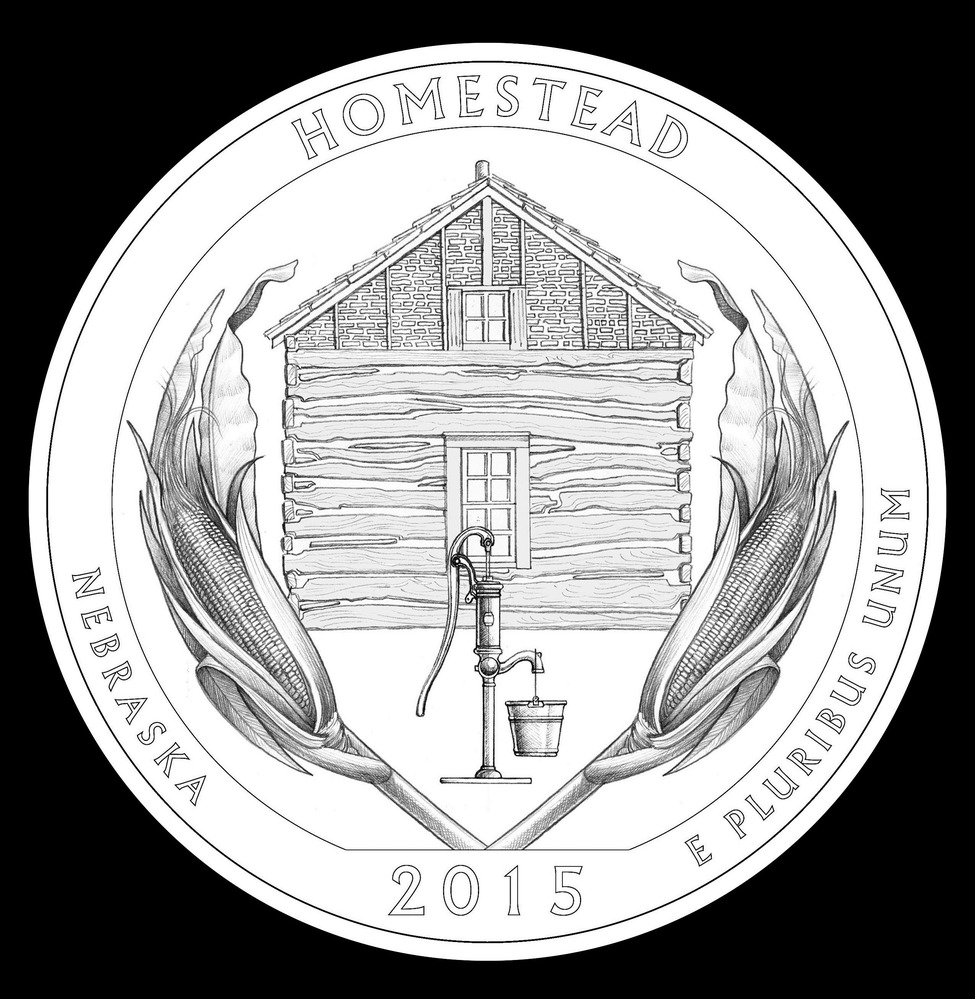
2015 · United States Mint image Official Mint line drawing; reverse design by Ronald D. Sanders. Design and artist source ↗
United States Mint quarter design · United States Mint. Open source ↗
- Quarter issue year
- 2015
- Retrieved
- 2026-10-30
- Image rights
- Image rights and source ↗
- Evidence
- Single source; not independently corroborated.
- Reuse
- NPS asset metadata: Public domain:Full Granting Rights.
- Rights
- NPS asset metadata: Public domain:Full Granting Rights.
Completed! The Palmer-Epard Cabin Stands Strong. · NPS/Robert Hartwig. Open source ↗
- Information date
- Not supplied by the source
- Retrieved
- 2026-10-30
- Catalog image date
- 11/19/2024
- Source scope
- Homestead National Historical Park
- Evidence
- Single source; not independently corroborated.
- Reuse
- Public domain:Full Granting Rights
- Rights
- Public domain:Full Granting Rights
Designation · National Park System directory. Open source ↗
- Information date
- Not supplied by the source
- Retrieved
- 2026-10-30
- Evidence
- Single source; not independently corroborated.
- Reuse
- Factual reference data; source attribution retained.
State or territory · National Park System directory. Open source ↗
- Information date
- Not supplied by the source
- Retrieved
- 2026-10-30
- Evidence
- Single source; not independently corroborated.
- Reuse
- Factual reference data; source attribution retained.
Park Map - Homestead National Historical Park · National Park Service, Harpers Ferry Center. Open source ↗
- Information date
- Not supplied by the source
- Retrieved
- 2026-10-30
- Source scope
- Homestead National Historical Park
- Download
- Official map PDF ↗
- Evidence
- Single source; not independently corroborated.
- Reuse
- Public domain; NPS map
- Rights
- Public domain; NPS map
About the Homestead Act · About the Homestead Act — National Park Service. Open source ↗
- Information date
- Not supplied by the source
- Retrieved
- 2026-10-30
- Source page last updated
- October 12, 2022
- Evidence
- Single source; not independently corroborated.
- Reuse
- NPS-authored U.S. government material is generally public domain; third-party content may have separate rights.
Creation of Homestead Historical Park · Creation of Homestead Historical Park — National Park Service. Open source ↗
- Information date
- Not supplied by the source
- Retrieved
- 2026-10-30
- Source page last updated
- March 14, 2022
- Evidence
- Single source; not independently corroborated.
- Reuse
- NPS-authored U.S. government material is generally public domain; third-party content may have separate rights.
People · People — National Park Service. Open source ↗
- Information date
- Not supplied by the source
- Retrieved
- 2026-10-30
- Source page last updated
- November 26, 2024
- Evidence
- Single source; not independently corroborated.
- Reuse
- NPS-authored U.S. government material is generally public domain; third-party content may have separate rights.
Places · Places — National Park Service. Open source ↗
- Information date
- Not supplied by the source
- Retrieved
- 2026-10-30
- Source page last updated
- July 17, 2026
- Evidence
- Single source; not independently corroborated.
- Reuse
- NPS-authored U.S. government material is generally public domain; third-party content may have separate rights.
Collections · Collections — National Park Service. Open source ↗
- Information date
- Not supplied by the source
- Retrieved
- 2026-10-30
- Source page last updated
- August 22, 2023
- Evidence
- Single source; not independently corroborated.
- Reuse
- NPS-authored U.S. government material is generally public domain; third-party content may have separate rights.
Stories · Stories — National Park Service. Open source ↗
- Information date
- Not supplied by the source
- Retrieved
- 2026-10-30
- Source page last updated
- September 4, 2025
- Evidence
- Single source; not independently corroborated.
- Reuse
- NPS-authored U.S. government material is generally public domain; third-party content may have separate rights.
Native Americans and the Homestead Act · Native Americans and the Homestead Act — National Park Service. Open source ↗
- Information date
- Not supplied by the source
- Retrieved
- 2026-10-30
- Source page last updated
- September 17, 2024
- Evidence
- Single source; not independently corroborated.
- Reuse
- NPS-authored U.S. government material is generally public domain; third-party content may have separate rights.
Presidential Quotes about the Homestead Act · Presidential Quotes about the Homestead Act — National Park Service. Open source ↗
- Information date
- Not supplied by the source
- Retrieved
- 2026-10-30
- Source page last updated
- September 19, 2019
- Evidence
- Single source; not independently corroborated.
- Reuse
- NPS-authored U.S. government material is generally public domain; third-party content may have separate rights.
Homestead Records · Homestead Records — National Park Service. Open source ↗
- Information date
- Not supplied by the source
- Retrieved
- 2026-10-30
- Source page last updated
- October 19, 2022
- Evidence
- Single source; not independently corroborated.
- Reuse
- NPS-authored U.S. government material is generally public domain; third-party content may have separate rights.
History and Culture · History and Culture — National Park Service. Open source ↗
- Information date
- Not supplied by the source
- Retrieved
- 2026-10-30
- Source page last updated
- May 7, 2024
- Evidence
- Single source; not independently corroborated.
- Reuse
- NPS-authored U.S. government material is generally public domain; third-party content may have separate rights.
Rural Electrification Act · Rural Electrification Act — National Park Service. Open source ↗
- Information date
- Not supplied by the source
- Retrieved
- 2026-10-30
- Source page last updated
- August 8, 2021
- Evidence
- Single source; not independently corroborated.
- Reuse
- NPS-authored U.S. government material is generally public domain; third-party content may have separate rights.
Homesteading Legacies · Homesteading Legacies — National Park Service. Open source ↗
- Information date
- Not supplied by the source
- Retrieved
- 2026-10-30
- Source page last updated
- August 22, 2021
- Evidence
- Single source; not independently corroborated.
- Reuse
- NPS-authored U.S. government material is generally public domain; third-party content may have separate rights.
About the Museum Collection · About the Museum Collection — National Park Service. Open source ↗
- Information date
- Not supplied by the source
- Retrieved
- 2026-10-30
- Source page last updated
- February 15, 2021
- Evidence
- Single source; not independently corroborated.
- Reuse
- NPS-authored U.S. government material is generally public domain; third-party content may have separate rights.
Archives · Archives — National Park Service. Open source ↗
- Information date
- Not supplied by the source
- Retrieved
- 2026-10-30
- Source page last updated
- February 14, 2021
- Evidence
- Single source; not independently corroborated.
- Reuse
- NPS-authored U.S. government material is generally public domain; third-party content may have separate rights.
Researcher Information · Researcher Information — National Park Service. Open source ↗
- Information date
- Not supplied by the source
- Retrieved
- 2026-10-30
- Source page last updated
- September 18, 2021
- Evidence
- Single source; not independently corroborated.
- Reuse
- NPS-authored U.S. government material is generally public domain; third-party content may have separate rights.
Future of the Collection · Future of the Collection — National Park Service. Open source ↗
- Information date
- Not supplied by the source
- Retrieved
- 2026-10-30
- Source page last updated
- September 18, 2021
- Evidence
- Single source; not independently corroborated.
- Reuse
- NPS-authored U.S. government material is generally public domain; third-party content may have separate rights.
Dempster Mill Manufacturing Company Archives · Dempster Mill Manufacturing Company Archives — National Park Service. Open source ↗
- Information date
- Not supplied by the source
- Retrieved
- 2026-10-30
- Source page last updated
- November 30, 2020
- Evidence
- Single source; not independently corroborated.
- Reuse
- NPS-authored U.S. government material is generally public domain; third-party content may have separate rights.
Write Your Homestead Story · Write Your Homestead Story — National Park Service. Open source ↗
- Information date
- Not supplied by the source
- Retrieved
- 2026-10-30
- Source page last updated
- February 13, 2023
- Evidence
- Single source; not independently corroborated.
- Reuse
- NPS-authored U.S. government material is generally public domain; third-party content may have separate rights.
Ecology · Nature — National Park Service. Open source ↗
- Information date
- October 1, 2024
- Retrieved
- 2026-10-30
- Evidence
- Single source; not independently corroborated.
- Reuse
- NPS webpage text; U.S. government work generally public domain. Third-party material may have separate rights.
Birds · Birds — National Park Service. Open source ↗
- Information date
- September 18, 2021
- Retrieved
- 2026-10-30
- Evidence
- Single source; not independently corroborated.
- Reuse
- NPS webpage text; U.S. government work generally public domain. Third-party material may have separate rights.
Plants · Plants — National Park Service. Open source ↗
- Information date
- September 12, 2024
- Retrieved
- 2026-10-30
- Evidence
- Single source; not independently corroborated.
- Reuse
- NPS webpage text; U.S. government work generally public domain. Third-party material may have separate rights.
Animals · Animals — National Park Service. Open source ↗
- Information date
- August 28, 2021
- Retrieved
- 2026-10-30
- Evidence
- Single source; not independently corroborated.
- Reuse
- NPS webpage text; U.S. government work generally public domain. Third-party material may have separate rights.
Natural Features & Ecosystems · Natural Features & Ecosystems — National Park Service. Open source ↗
- Information date
- March 1, 2021
- Retrieved
- 2026-10-30
- Evidence
- Single source; not independently corroborated.
- Reuse
- NPS webpage text; U.S. government work generally public domain. Third-party material may have separate rights.
Environmental Factors · Environmental Factors — National Park Service. Open source ↗
- Information date
- September 12, 2024
- Retrieved
- 2026-10-30
- Evidence
- Single source; not independently corroborated.
- Reuse
- NPS webpage text; U.S. government work generally public domain. Third-party material may have separate rights.
Mammals · Mammals — National Park Service. Open source ↗
- Information date
- September 18, 2021
- Retrieved
- 2026-10-30
- Evidence
- Single source; not independently corroborated.
- Reuse
- NPS webpage text; U.S. government work generally public domain. Third-party material may have separate rights.
Education Center · National Park Service park structured data. Open source ↗
- Information date
- Not supplied by the source
- Retrieved
- 2026-10-30
- Evidence
- Single source; not independently corroborated.
- Reuse
- NPS-supplied text; NPS-authored U.S. government work is generally public domain, subject to third-party rights.
Physical Address · Official park structured information. Open source ↗
- Information date
- Not supplied by the source
- Retrieved
- 2026-10-30
- Evidence
- Single source; not independently corroborated.
- Reuse
- NPS-supplied text; NPS-authored government work generally public domain, subject to third-party rights.
Mailing Address · Official park structured information. Open source ↗
- Information date
- Not supplied by the source
- Retrieved
- 2026-10-30
- Evidence
- Single source; not independently corroborated.
- Reuse
- NPS-supplied text; NPS-authored government work generally public domain, subject to third-party rights.
Telephone · Official park structured information. Open source ↗
- Information date
- Not supplied by the source
- Retrieved
- 2026-10-30
- Evidence
- Single source; not independently corroborated.
- Reuse
- NPS-supplied text; NPS-authored government work generally public domain, subject to third-party rights.
Recreation visits · National Park Service Visitor Use Statistics. Open source ↗
- Information date
- 2025
- Retrieved
- 2026-10-30
- Methodology
- NPS reporting unit; annual total is the sum of 12 monthly recreation visit estimates.
- Reporting unit
- Homestead NHP
- Evidence
- Single source; not independently corroborated.
- Reuse
- Factual reference data; source attribution retained.